
Entrepreneurship is often positioned as a pathway to opportunity, innovation, and economic mobility. For many individuals, it represents a chance to create something new and build financial independence. However, for underserved and underrepresented communities, the path to entrepreneurship is rarely straightforward. Structural barriers, limited access to resources, and gaps in support systems often make the journey significantly more challenging.
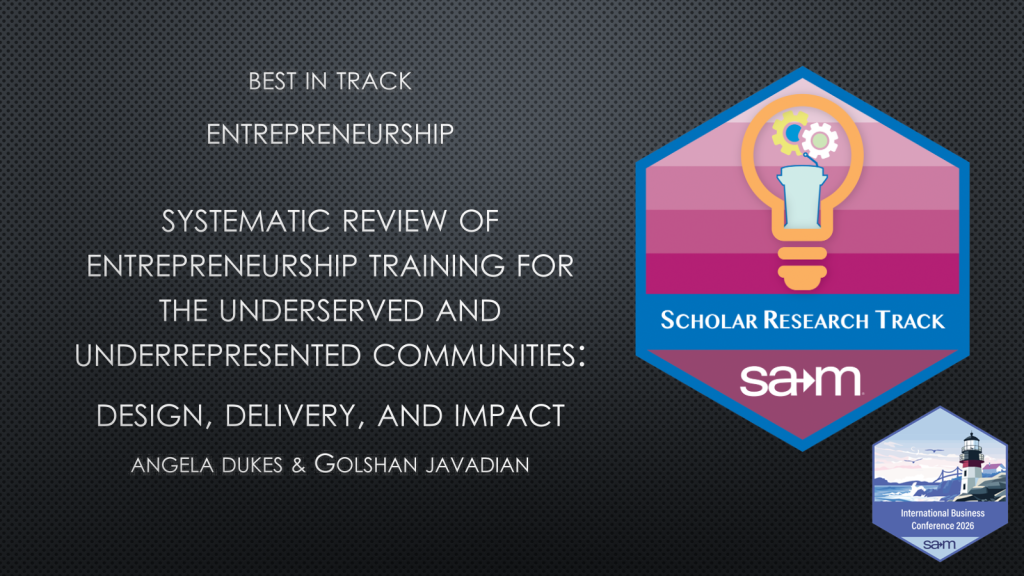
Angelea Dukes and Golshan Javadian’s research confronts this reality with both clarity and purpose. As recipients of the Best in Track Award for Entrepreneurship, they are recognized for their paper, “Systematic Review of Entrepreneurship Training for the Underserved and Underrepresented Communities: Design, Delivery, and Impact.” Their work provides a comprehensive synthesis of existing research to better understand what makes entrepreneurship training effective for those who need it most.
At the center of the study is a fundamental question: what do we truly know about how entrepreneurship training programs support marginalized populations? To answer this, the authors conducted a systematic review of 32 peer-reviewed studies, applying a structured methodology to analyze program design, delivery methods, and measurable outcomes. This approach allows for a clearer understanding of both what is working and where meaningful gaps remain.
One of the most important findings is that effective programs are not one-dimensional. The research shows that the strongest outcomes occur when training combines culturally relevant pedagogy, mentorship, and experiential learning. These elements work together to build not only technical business skills, but also confidence, resilience, and a sense of agency among participants. This holistic approach recognizes that entrepreneurship is as much about mindset and support as it is about knowledge.
The study also highlights the importance of tailoring programs to the specific contexts of the communities they serve. Programs that incorporate cultural relevance and community-driven design are more likely to engage participants and produce meaningful results. Whether through adapting content to reflect local values or addressing barriers unique to specific groups, these approaches create environments where participants can see themselves reflected in the entrepreneurial journey.
At the same time, the research does not shy away from identifying ongoing challenges. One of the most significant gaps is the lack of long-term evaluation of program outcomes. While many initiatives demonstrate short-term success in increasing entrepreneurial intent and confidence, there is limited data on business sustainability and long-term economic impact. This gap makes it difficult to fully assess the effectiveness of these programs and to refine them for greater impact over time.
Access to financial resources remains another persistent barrier. Even when participants develop strong business ideas and foundational skills, limited access to capital can prevent those ideas from becoming sustainable ventures. The research underscores the importance of integrating financial support mechanisms and addressing systemic funding inequities as part of a comprehensive approach to entrepreneurship development.
There is also a broader leadership implication embedded in this work. Entrepreneurship programs are not simply educational initiatives; they are tools for economic and social transformation. Leaders designing and supporting these programs must think beyond traditional models and consider how to create systems that are inclusive, adaptive, and responsive to the realities participants face. This requires collaboration across education, policy, and community organizations to ensure that programs are both accessible and sustainable.
The impact of these programs extends far beyond individual participants. When designed effectively, entrepreneurship training can contribute to stronger communities, increased economic activity, and the development of generational wealth. The ripple effects of these outcomes highlight the importance of investing in programs that are intentionally built to address systemic inequities.
The Best in Track Award for Entrepreneurship recognizes research that connects insight with impact. Dukes and Javadian’s work exemplifies this by providing a framework that is both grounded in evidence and focused on real-world application. It offers a roadmap for those seeking to design programs that do more than educate, but instead empower and transform.
As conversations around equity, access, and economic opportunity continue to evolve, the role of entrepreneurship training will become increasingly important. The challenge is not simply to expand access, but to ensure that the programs being offered are effective, inclusive, and capable of producing lasting change.
Angelea Dukes and Golshan Javadian’s research serves as a reminder that meaningful progress requires intentional design, sustained support, and a commitment to understanding the communities we aim to serve.