
Healthcare systems are built on assumptions. Some are grounded in decades of clinical practice, while others persist simply because they have not been meaningfully challenged. One of the most enduring assumptions in physical therapy is that more care leads to better outcomes. More sessions, more supervision, and more time in treatment are often equated with higher quality care and stronger results.
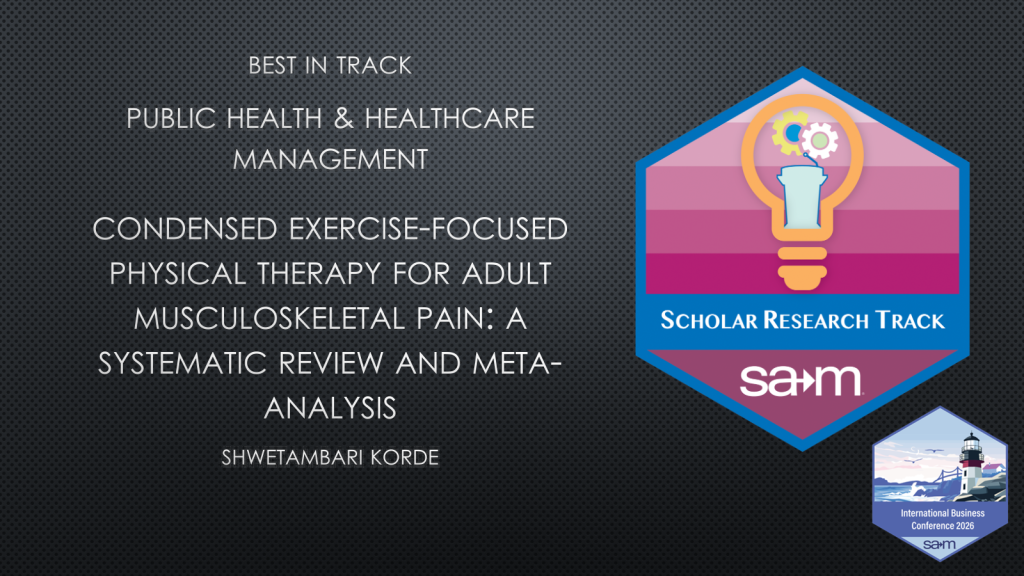
Shwetambari Korde’s research takes a thoughtful and data-driven look at that belief. As the recipient of the Best in Track Award for Public Health & Healthcare Management, Korde is being recognized for her paper, “Condensed Exercise-Focused Physical Therapy for Adult Musculoskeletal Pain: A Systematic Review and Meta-analysis.” Her work examines whether fewer, more focused interactions between patient and provider can deliver outcomes comparable to traditional multi-session rehabilitation models.
At the center of the study is a question with both clinical and operational implications. Do patients truly require multiple sessions of supervised physical therapy to improve, or can a more streamlined approach achieve similar results? This question is particularly relevant as healthcare systems face increasing pressure to balance quality of care with cost, access, and capacity constraints.
Musculoskeletal pain remains one of the leading causes of disability worldwide, affecting billions of individuals and placing a significant burden on healthcare systems. Traditional care models often rely on multi-session therapy programs that demand considerable time, financial investment, and ongoing patient engagement. While these approaches can be effective, they also create barriers, particularly for individuals with limited access to care or competing life demands.
Korde’s research evaluates whether a more efficient model can produce comparable outcomes. Through a systematic review and meta-analysis of randomized controlled trials involving more than 2,000 participants, the study compares single-session, exercise-focused physical therapy with traditional multi-session approaches. The findings challenge conventional thinking in meaningful ways.
Across multiple timeframes, including short, mid, and long-term follow-up, outcomes related to pain, physical function, and quality of life were largely similar between the two approaches. While multi-session therapy demonstrated a small advantage in pain reduction at the six-month mark, the difference was not clinically significant and did not persist over time. These results suggest that the intensity of care may not be the defining factor in long-term recovery.
This finding has important implications for how healthcare is delivered. If condensed, education- and exercise-focused therapy can achieve comparable outcomes, it opens the door to more efficient and accessible models of care. Patients may be able to receive effective treatment with fewer visits, reducing both financial burden and time commitment. For healthcare systems, this approach can help reduce wait times, expand access, and improve overall capacity without sacrificing quality.
There is also a meaningful shift in how patient engagement is viewed. Korde’s research emphasizes the importance of education and self-management as central components of recovery. Rather than relying heavily on repeated in-person sessions, patients are equipped with the knowledge and tools necessary to manage their condition independently. This aligns with broader trends in healthcare that prioritize patient empowerment, long-term behavior change, and proactive management of chronic conditions.
At the same time, the research acknowledges that a one-size-fits-all approach is not appropriate. Clinical complexity, comorbidities, and individual patient preferences all influence the level of care required. The findings reinforce the importance of shared decision-making, where clinicians and patients work together to determine the most appropriate treatment plan based on evidence, context, and individual needs.
From a systems perspective, implementing condensed care models requires more than adjusting clinical protocols. It involves rethinking how services are structured, how outcomes are measured, and how providers are trained to deliver care efficiently. It also raises important considerations related to reimbursement models, patient expectations, and the role of digital tools in supporting follow-up and ongoing engagement.
The broader takeaway is both simple and significant. Efficiency in healthcare is not about reducing care, but about delivering the right care in the most effective way. Korde’s work challenges the assumption that more is always better and replaces it with a more nuanced understanding of value.
The Best in Track Award for Public Health & Healthcare Management recognizes research that advances both knowledge and practice. This work exemplifies that goal by offering a data-driven framework for improving care delivery while maintaining a strong focus on patient outcomes.
As healthcare systems continue to evolve, the ability to question long-standing assumptions and adapt care models will become increasingly important. The future of healthcare will not be defined by the volume of services delivered, but by the effectiveness, accessibility, and sustainability of those services.
Shwetambari Korde’s research serves as a timely reminder that meaningful innovation often comes not from adding complexity, but from refining and optimizing what already exists.