
Colleges and universities have no shortage of data. Retention rates, graduation rates, course completion, student engagement, financial aid utilization. The challenge is not collecting the data. The challenge is knowing what to do with it.
Brian Mallett’s work addresses that gap directly.
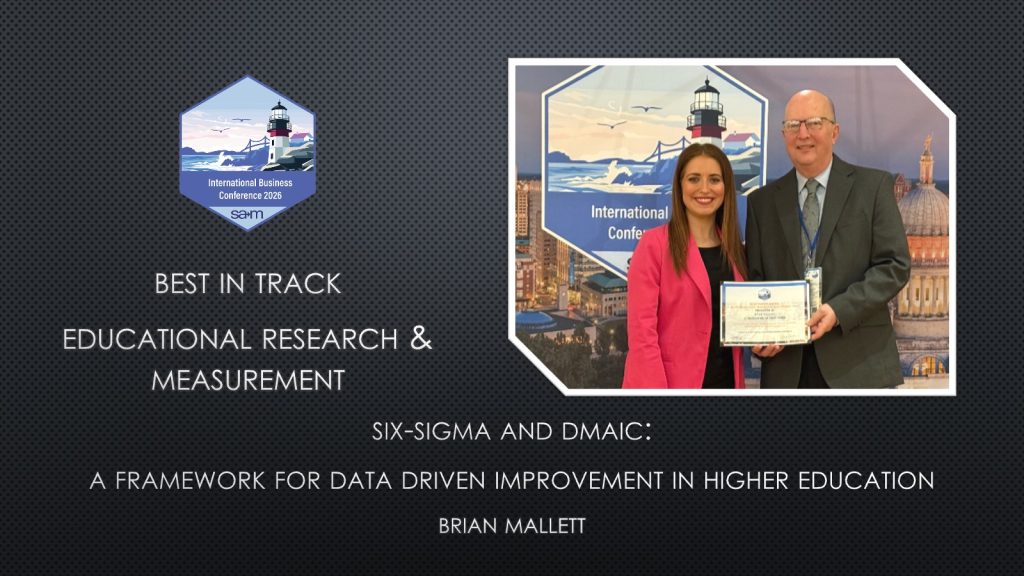
As the recipient of the Best in Track Award for Educational Research & Measurement, Mallett is being recognized for his paper, “Six-Sigma and DMAIC: A Framework for Data-Driven Improvement in Higher Education.” His research explores how institutions can move beyond analysis and begin translating data into meaningful, measurable action.
At the center of his work is a simple but powerful question. Why do students leave before graduating?
Across higher education, this question continues to drive strategic planning and resource allocation. Institutions invest heavily in support programs, technology, and advising structures, yet retention and graduation rates remain persistent challenges. Mallett’s research suggests that the issue is not a lack of effort, but a lack of structured methodology.
His approach introduces Six Sigma and the DMAIC framework, Define, Measure, Analyze, Improve, and Control, as a model for addressing student success. While widely used in industry, these tools have been less commonly applied in higher education. Mallett’s work demonstrates how they can be adapted to examine institutional processes with the same level of rigor used in manufacturing and operations.
The research draws on a decade of data from Georgia Southwestern State University, where retention rates averaged 64 percent over a ten-year period, below institutional targets. Rather than treating this as a static metric, the study breaks the problem into measurable components, allowing for a deeper understanding of where and why students disengage.
One of the most compelling aspects of the study is its focus on root causes. Through the use of tools such as control charts, Pareto analysis, and fishbone diagrams, the research identifies key factors that influence student outcomes. Academic performance, course completion, engagement, and preparation all emerge as critical drivers.
For example, students with lower first-year GPA and those withdrawing from multiple courses show significantly lower retention. Course completion rates also vary widely across subject areas and student levels, highlighting specific points in the academic journey where intervention may be most effective.
The study does not stop at analysis. It moves into action.
Using the DMAIC framework, Mallett outlines a series of targeted initiatives designed to improve outcomes. These include structured academic planning for first-year students, enhanced use of learning management systems, early warning systems for at-risk students, and redesigned courses aimed at improving completion rates.
What makes these initiatives particularly valuable is their measurability. Each action is tied to specific performance indicators, allowing institutions to track progress and adjust strategies over time. This creates a feedback loop where data informs action, and action generates new data for continuous improvement.
The research also highlights the importance of engagement. Students who participate in athletics, select a major early, or engage in campus activities show higher retention rates. These findings reinforce the idea that student success is not driven by a single factor, but by a combination of academic, social, and structural elements.
There is a broader implication in this work that extends beyond higher education.
Mallett’s research demonstrates the value of applying structured problem-solving methodologies to complex human systems. Whether in education, business, or public service, organizations often struggle with translating insight into action. The DMAIC framework provides a pathway for doing exactly that.
The Best in Track Award for Educational Research & Measurement recognizes work that advances both understanding and application. Mallett’s research does both. It provides a clear framework for improving student success while offering a model that can be adapted across institutions.
As higher education continues to evolve, the ability to make data-driven decisions will become even more critical. Institutions that can move beyond analysis and implement structured, measurable improvements will be better positioned to support student success.
Brian Mallett’s work is a reminder that data alone does not create change. It is what organizations do with that data that makes the difference.