
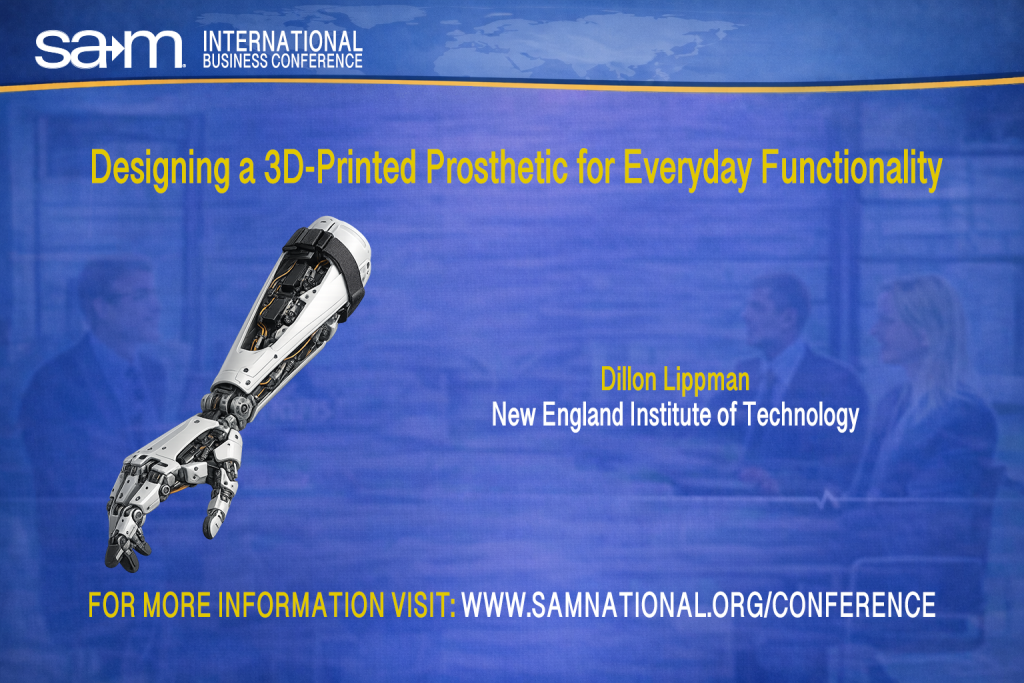
Access to prosthetic technology has advanced dramatically over the past several decades. Yet for many individuals, affordability remains a barrier. Traditional prosthetic limbs often require specialized manufacturing, proprietary components, and significant financial investment. This reality creates a gap between technological possibility and practical accessibility. This student research project seeks to close that gap by designing a cost effective, open source, 3D printed prosthetic arm intended for everyday functionality.
The project centers on a powerful idea: what if someone could download a digital file, print the components, assemble the parts, and walk away with a functional prosthetic limb? Advances in 3D printing technology, servo motors, and programmable components make this concept increasingly achievable. By combining accessible hardware with thoughtful engineering design, the project demonstrates how modern fabrication tools can expand access to assistive technology.
The prosthetic design incorporates affordable materials and components that balance functionality with cost control. Servo motors enable controlled movement, while the mechanical structure is engineered for durability and ergonomic usability. Design decisions reflect careful trade offs between power, precision, weight, and manufacturability. Rather than pursuing high end commercial complexity, the focus is on practical daily use and replicability.
A defining feature of this capstone project is its commitment to open source development. All files, assembly instructions, and programming components are made freely available. This transparency allows users, educators, and engineers to replicate, modify, and improve the design. By removing intellectual property barriers, the project aligns with a broader movement toward democratized innovation in medical robotics and bionics.
The implications extend beyond engineering design. In healthcare systems where prosthetic costs can be prohibitive, open source and digitally manufactured solutions introduce new pathways for accessibility. Educational institutions and makerspaces can become contributors to assistive technology development. Communities that previously lacked resources may gain local fabrication capability, reducing dependency on centralized production.
For management and engineering leaders, this session highlights how technology strategy, cost control, and social impact intersect. It demonstrates that innovation is not only about sophistication but also about accessibility and scalability. Designing for affordability requires intentional engineering decisions, structured development processes, and a clear understanding of user needs.
This presentation includes a live demonstration of the 3D printed prosthetic, offering participants the opportunity to see its functionality firsthand. It provides insight into the research, design, and programming process behind creating a practical, low cost assistive device.
Author and Affiliation
Dillon Lippman, New England Institute of Technology
This presentation will be delivered in person at the SAM International Business Conference as part of the Invitation Only Submissions track. Attendees will explore how 3D printing, open source design, and engineering management principles can expand access to prosthetic technology while balancing functionality and affordability. For more information visit www.samnational.org/conference