
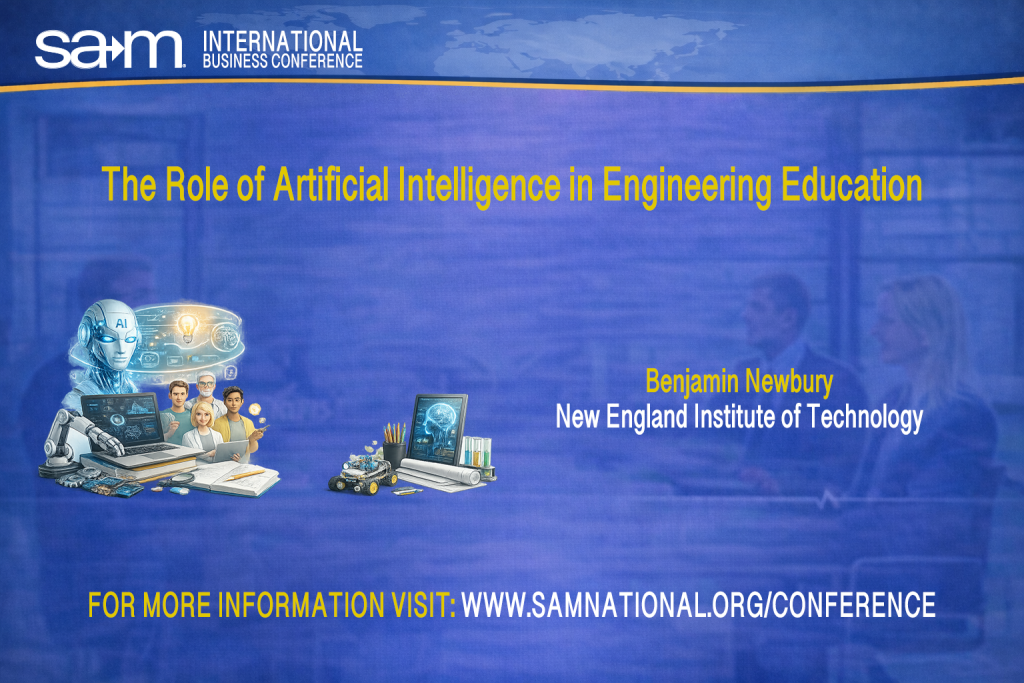
Artificial Intelligence is no longer a distant concept in higher education. It is already reshaping how students learn, how instructors teach, and how institutions evaluate performance. In engineering education, where technical precision and problem solving are central, AI presents both an opportunity and a leadership challenge. This accepted student research presentation explores how AI is currently being used in engineering programs and what responsible integration should look like moving forward.
Drawing on a comprehensive literature review, the study examines how AI applications such as generative tools, automated assessment systems, and personalized feedback platforms are being adopted at undergraduate and graduate levels. The findings suggest that AI can increase student engagement, reinforce conceptual understanding, and provide more timely feedback. In environments where faculty workload is heavy and class sizes vary, AI-supported tools offer the potential to enhance learning efficiency without sacrificing instructional quality.
At the same time, the research identifies important concerns. Students generally report positive perceptions of AI tools, yet issues related to bias, reliability, and academic integrity remain unresolved. The literature also reveals notable gaps. Few studies center on instructors’ perspectives. Limited research focuses on graduate-level engineering students. There is also a need for more rigorous, randomized controlled trials to measure long-term effectiveness rather than short-term perception.
To move beyond theory, the research incorporates qualitative semi-structured interviews with fifteen full- and part-time engineering faculty members at a small New England college. These interviews explore instructors’ knowledge of AI tools, training experiences, and readiness to integrate AI into their courses. Rather than assuming adoption is purely technological, the study highlights that successful integration depends on faculty development, institutional culture, and clearly defined instructional objectives.
From a management perspective, this presentation reframes AI adoption as a strategic decision rather than a reactive trend. Engineering programs must determine not only whether AI can be used, but how it should be used to preserve rigor, equity, and professional standards. Best practices for integration require clarity around learning outcomes, transparency with students, and ongoing faculty training. Without leadership alignment, AI risks becoming fragmented across courses rather than embedded into coherent academic strategy.
Designed for educators, administrators, and technology leaders, this in-person presentation invites attendees to think critically about AI as a tool for enhancement rather than replacement. Engineering education sits at the intersection of innovation and responsibility. By grounding AI adoption in research, instructor voice, and structured implementation, institutions can harness its benefits while safeguarding educational integrity.
Author and Affiliation
Benjamin Newbury, New England Institute of Technology
This presentation will be delivered in person at the SAM International Business Conference and contributes to broader conversations about technology-enhanced assessment, faculty development, and data-informed decision making in higher education. For more information visit www.samnational.org/conference