
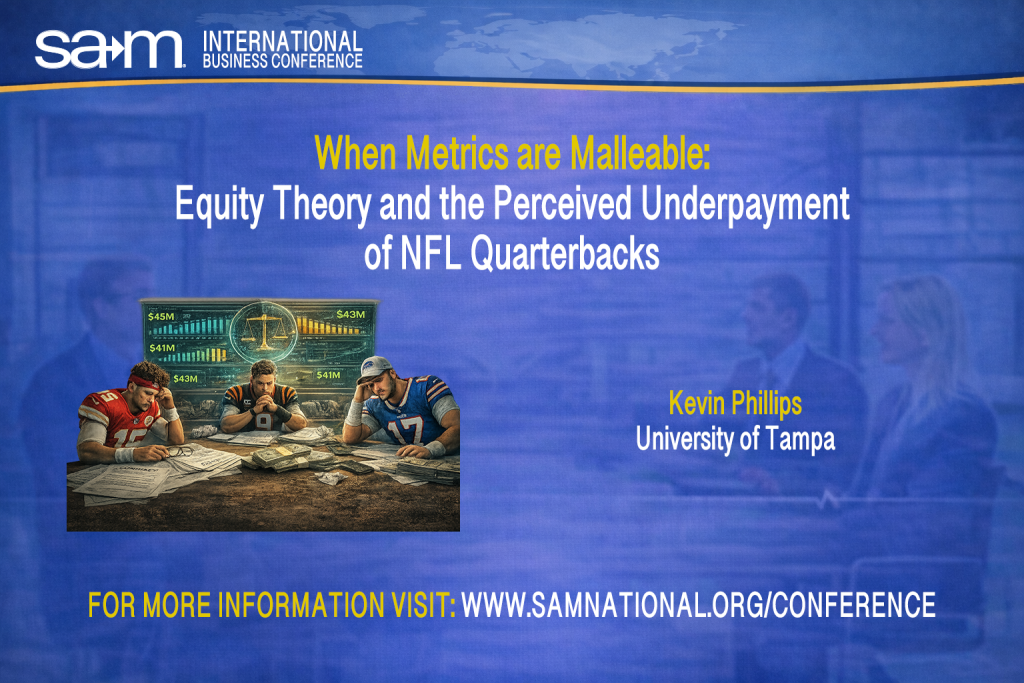
Compensation dissatisfaction is often framed as a problem of low pay. Yet even among the highest earners in the workforce, feelings of inequity persist. Professional sports provide a visible and compelling example. NFL quarterbacks routinely sign contracts worth tens of millions of dollars, yet many still express frustration, dissatisfaction, and a belief that they are underpaid relative to peers. This tension raises a broader management question: how do perceptions of fairness form when performance metrics are ambiguous?
This accepted scholarly research presentation applies equity theory to examine how compensation dissatisfaction emerges among elite performers when evaluation criteria lack clarity. Rather than focusing on absolute pay, the study emphasizes relative comparison and the psychological processes that shape how individuals assess fairness. The research argues that when performance objectives are malleable or inconsistently applied, even extraordinary compensation fails to resolve perceived inequity.
Using NFL quarterbacks as a high-profile case, the presentation illustrates how ambiguous performance metrics contribute to dissatisfaction. While statistics such as passing yards, touchdowns, interceptions, and win records are readily available, no universal framework exists for weighting these inputs. As a result, quarterbacks evaluate their compensation not against fixed standards but against peers, contracts reported in the media, and shifting narratives of value. The absence of clear benchmarks creates space for subjective comparison and persistent discontent.
The study situates this dynamic within equity theory, which suggests that individuals assess fairness by comparing their inputs and outcomes to those of others. When evaluation criteria are unclear, comparisons multiply and dissatisfaction intensifies. In elite roles where performance is complex and multi-dimensional, ambiguity becomes a catalyst for frustration rather than a neutral condition.
Beyond professional sports, the implications extend directly to organizational leadership and human resource management. If individuals earning at the highest levels experience dissatisfaction due to unclear evaluation standards, the risk is even greater across traditional organizational settings. Employees at all income levels are likely to question fairness when performance expectations are inconsistent or poorly communicated. Increasing pay alone does not resolve these concerns if the underlying evaluation system remains unclear.
Designed for scholars, educators, and management practitioners, this session reinforces the importance of transparent performance frameworks. Clear metrics do not eliminate comparison, but they reduce ambiguity and provide a shared reference point for evaluating contributions. By clarifying how performance is assessed, organizations can mitigate dissatisfaction, strengthen trust, and support motivation regardless of compensation level.
Author and Affiliation
Kevin Phillips, University of Tampa
This presentation will be delivered in person at the SAM International Business Conference and will invite participants to engage with equity theory, compensation strategy, and performance measurement through a lens that bridges elite sports and everyday organizational life. For more information visit www.samnational.org/conference