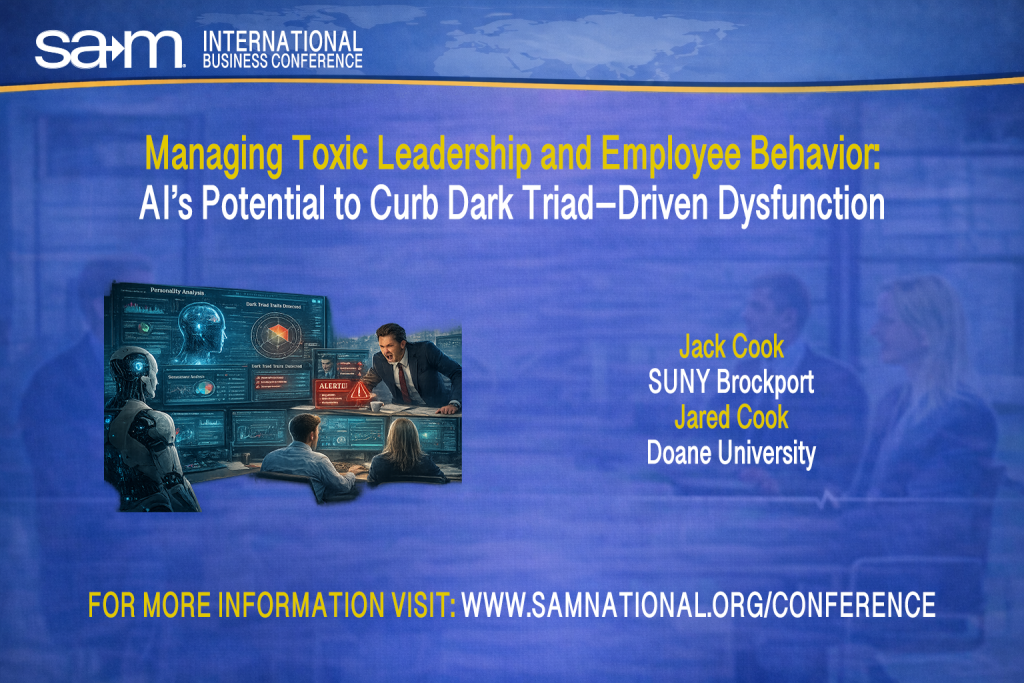
Toxic leadership and counterproductive employee behavior remain persistent challenges for organizations, often driven by personality traits that undermine trust, collaboration, and ethical decision making. Narcissism, Machiavellianism, and psychopathy, commonly referred to as the Dark Triad, can distort workplace relationships, erode team cohesion, and create environments where manipulation and self-interest outweigh collective goals. As organizations search for more effective governance and leadership development tools, artificial intelligence is increasingly positioned as a potential intervention.
This accepted scholarly research presentation explores whether AI can function as a workplace equalizer by reducing the influence of Dark Triad traits in leadership and employee behavior. Rather than framing AI as a replacement for human judgment, the study examines how AI-supported systems may help standardize decision making, limit bias, and provide more consistent feedback in environments where toxic behaviors often thrive.
Drawing on an extensive review of existing literature, the presentation examines how AI-driven tools such as sentiment analysis, standardized performance evaluations, and real-time behavioral feedback could mitigate the negative effects of manipulative or self-serving leadership styles. By reducing reliance on subjective assessments, AI may help organizations interrupt patterns of favoritism, coercion, and counterproductive work behavior that often accompany Dark Triad–driven dysfunction.
At the same time, the research takes a critical view of AI’s limitations. Concerns related to privacy, employee trust, surveillance, and unintended consequences are central to the discussion. The study emphasizes that AI implementation must be guided by ethical frameworks that balance transparency, accountability, and respect for individual autonomy while addressing toxic behaviors.
Designed for scholars, practitioners, and organizational leaders, this session contributes to ongoing conversations about leadership effectiveness, workplace fairness, and ethical AI governance. Attendees will gain insight into how AI may support healthier workplace cultures while recognizing the risks and responsibilities associated with technology-driven management interventions.
Authors and Affiliations
Jack Cook, SUNY Brockport
Jared Cook, Doane University
This presentation will be delivered virtually at the SAM International Business Conference and will invite participants to engage with emerging research on toxic leadership, workplace behavior, and the evolving role of AI in organizational governance. For more information visit www.samnational.org/conference