
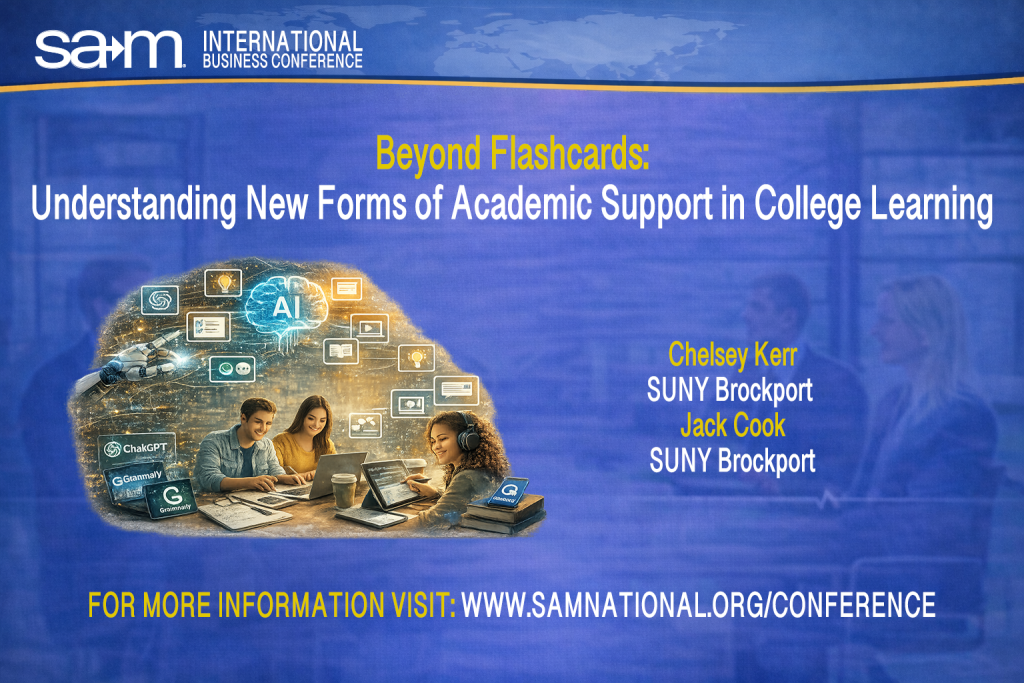
Artificial intelligence is rapidly reshaping how college students study, write, and manage their learning. Tools such as ChatGPT, Grammarly, and Quizlet AI are now embedded in everyday academic routines, offering personalized feedback, idea generation, and organizational support that extend far beyond traditional study methods like flashcards and note memorization. As these tools become more prevalent, they are transforming not only learning strategies but also conversations around academic integrity, equity, and institutional responsibility.
This accepted faculty and student research presentation examines how AI-enabled academic support tools are influencing higher education learning practices. Rather than focusing solely on concerns about misuse, the study takes a balanced view, exploring both the benefits and risks associated with AI adoption in college learning environments. The research situates AI as a powerful support mechanism that can enhance metacognition, motivation, and self-regulated learning when used responsibly.
Drawing on a comprehensive review of peer-reviewed research published between 2020 and 2025, the presentation synthesizes empirical studies, theoretical analyses, and case-based research to identify emerging patterns in student use of AI tools. The findings highlight how AI can improve learning efficiency, personalization, creativity, and accessibility, while also surfacing persistent challenges such as overreliance, misinformation, and unequal access.
The study also addresses the ethical dimensions of AI in education, including questions of authorship, fairness, accountability, and transparency. It emphasizes the need for institutional strategies that prioritize AI literacy, clear policy guidance, and ethical governance rather than relying solely on prohibition or enforcement. By integrating educational and managerial perspectives, the research connects individual learning behaviors with broader institutional policy design.
Designed for scholars, educators, and administrators, this session contributes to ongoing discussions about responsible AI adoption in higher education. Attendees will gain insight into how colleges and universities can leverage AI-powered academic support tools to enhance learning outcomes while preserving academic integrity and promoting equity.
Authors and Affiliations
Chelsey Kerr, SUNY Brockport
Jack Cook, SUNY Brockport
This presentation will be delivered virtually at the SAM International Business Conference and will invite participants to engage with emerging research on AI, academic support, and the future of learning in higher education. Learn more at www.samnational.org/conference