
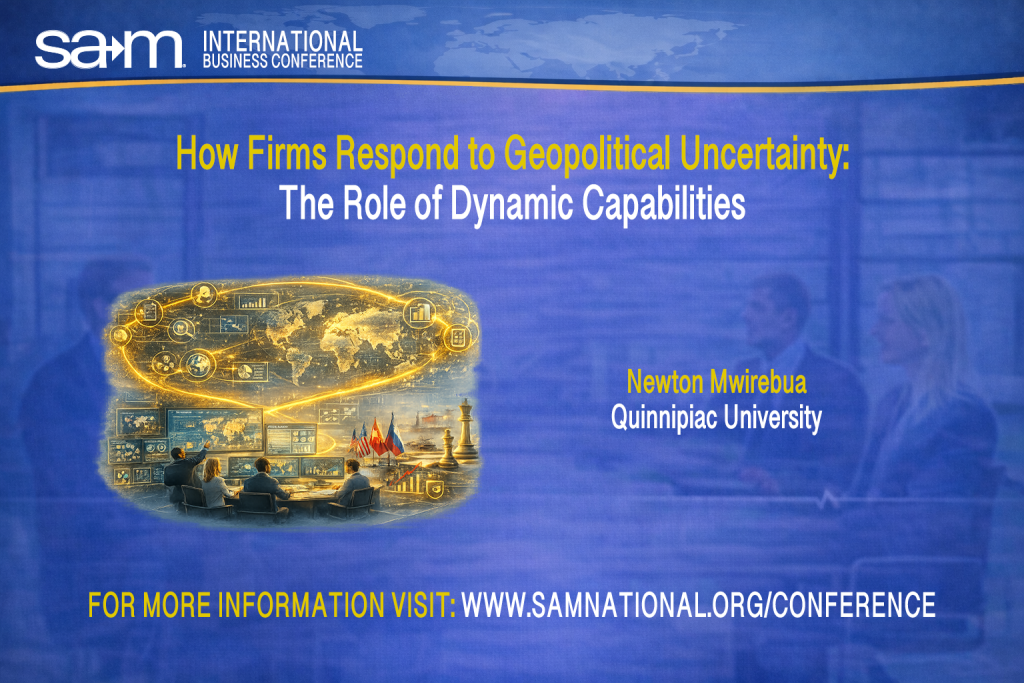
Geopolitical uncertainty has become a defining feature of the global business environment. Trade wars, economic sanctions, export controls, and regional conflicts increasingly shape strategic decision-making for multinational firms. Yet while dynamic capabilities theory explains how organizations adapt to volatile environments, less attention has been given to how firms operationalize these capabilities in response to geopolitical risk. This accepted student research presentation addresses that gap by examining the concrete practices firms use to sense, interpret, and respond to geopolitical turbulence.
The study develops a conceptual framework that links geopolitical uncertainty to firm-level strategic action through the deployment of analytical tools such as PESTEL analysis, risk mapping, and scenario planning. Rather than treating dynamic capabilities as abstract constructs, the research positions these tools as interpretive mechanisms that translate diffuse geopolitical signals into prioritized risks, strategic commitments, and resource reconfigurations. In this way, the framework clarifies how sensing, seizing, and reconfiguring are enacted under conditions of non-market risk.
Illustrative examples from Apple and Nvidia demonstrate how firms apply different analytical tools to support distinct clusters of dynamic capabilities. Apple’s approach highlights supply chain diversification as a response to geopolitical volatility, while Nvidia’s experience illustrates strategic adaptation to semiconductor export controls. Together, these cases show how structured analysis enables firms to build geopolitical resilience while maintaining innovation capacity and competitive advantage.
Designed for scholars and practitioners interested in strategic management, international business, and organizational agility, this session offers a practical lens for understanding how firms navigate geopolitical uncertainty. Attendees will gain insight into how analytical frameworks can strengthen strategic foresight, guide resource reallocation, and support sustained performance in an increasingly fragmented global economy.
Author and Affiliation
Newton Mwirebua, Quinnipiac University
Join us at the SAM International Business Conference to engage with this research and explore how dynamic capabilities can help firms respond effectively to geopolitical risk. This in-person presentation contributes to ongoing conversations about resilience, strategic planning, and organizational adaptation in uncertain global contexts. Learn more at www.samnational.org/conference