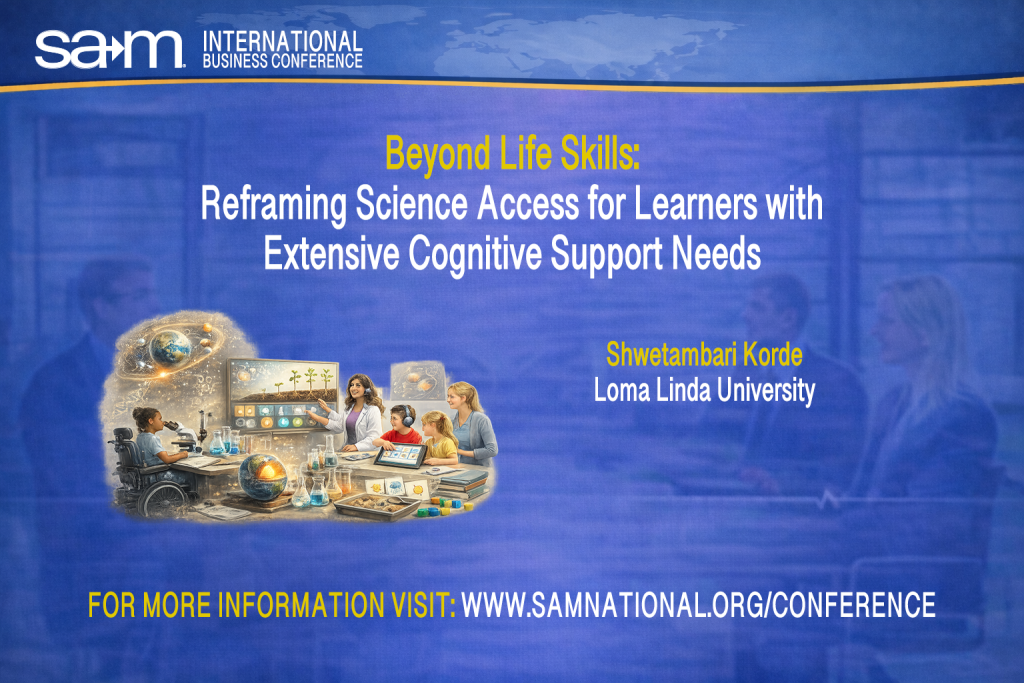
Access to rigorous science education has historically been limited for learners with extensive cognitive support needs, often confined to life-skills-based instruction rather than meaningful engagement with core scientific concepts. This accepted practitioner research presentation challenges that paradigm by reframing science access as both inclusive and conceptually rich, positioning accessibility and rigor as complementary rather than competing priorities.
Grounded in Universal Design for Learning (UDL) and Evidence-Centered Design (ECD), the research presents a design-based framework for developing alternate science content expectations and assessments aligned with general education standards. Rather than reducing expectations, the framework intentionally models learner variability, including communication modes, sensory processing, and cognitive load, to preserve construct relevance while removing unnecessary barriers. The work spans elementary, middle, and high school contexts, ensuring continuity of scientific engagement across grade levels.
The presentation draws on iterative expert review and multi-state pilot implementation to examine how accessible task design can elicit meaningful evidence of conceptual understanding. Findings indicate that most assessment items met both accessibility and content criteria, with targeted refinements improving tasks that initially posed undue challenge. Exemplars shared in the session demonstrate how guided investigations, structured observations, and choice-based responses can support authentic scientific reasoning without diluting disciplinary integrity.
Designed for researchers, educators, assessment developers, and educational leaders, this session advances inclusive science education by offering practical tools and theoretical grounding. Attendees will gain insight into how accessible science instruction and assessment can support learner agency, educator decision-making, and long-term participation in scientific learning for students with extensive cognitive support needs.
Author and Affiliation
Shwetambari Korde
Loma Linda University and New Jersey Disc Center
Join us at the SAM International Business Conference to explore how inclusive design can expand access to rigorous science learning. This presentation will be delivered virtually, allowing participants to engage from anywhere in the world.
Register to attend at www.samnational.org/conference and take part in conversations shaping the future of inclusive education and assessment.