
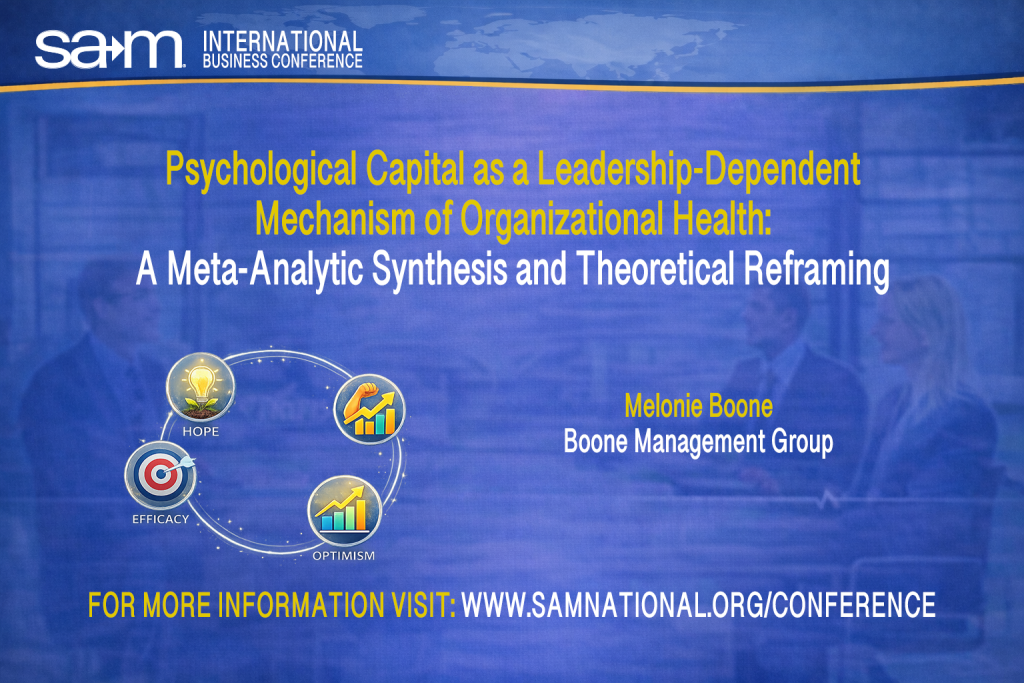
Psychological Capital, commonly defined through the dimensions of hope, efficacy, resilience, and optimism, has long been associated with individual performance and well-being. This accepted scholarly research presentation advances the conversation by reframing Psychological Capital as a leadership-dependent mechanism that shapes organizational health at the system level.
Drawing on a comprehensive meta-analytic synthesis of Psychological Capital research published between 2002 and 2025, this study integrates findings across industries, cultures, and organizational hierarchies. The analysis reveals consistent positive relationships between Psychological Capital and indicators of organizational health, including psychological safety, adaptability, engagement, climate strength, and collective resilience. Importantly, the research demonstrates that these effects are amplified when Psychological Capital resides in leaders, particularly in environments characterized by uncertainty and complexity.
The presentation challenges traditional leadership models that focus primarily on observable behaviors or competencies. Instead, it positions Psychological Capital as a foundational psychological resource that enables leaders to sustain influence, shape climate, and foster healthy organizational systems. Through mechanisms such as cognitive framing, emotional contagion, and behavioral modeling, leader Psychological Capital becomes transmissible, influencing norms, expectations, and collective functioning across organizational levels.
In addition to theoretical repositioning, the session offers applied implications for leadership assessment and development. Organizations are encouraged to move beyond competency-only frameworks toward resource-based diagnostics that identify and cultivate psychological capacity as a precursor to effective leadership. This perspective introduces new possibilities for leadership development architecture, culture shaping, and system-level interventions designed to enhance organizational health.
Author and Affiliation
Melonie Boone, PhD, Boone Management Group
Join us at the SAM International Business Conference to explore how Psychological Capital functions as a critical psychological infrastructure for leadership and organizational health. This presentation will be delivered in person and is ideal for scholars and practitioners interested in leadership development, organizational behavior, and measurement-driven approaches to healthy organizations.
Register to attend the conference at www.samnational.org/conference and engage with research that reframes how leaders influence organizational systems.