
At the highest level of the SAM Collegiate Case Competition, the Open Division brought together advanced student teams to tackle a complex, real-world challenge with the depth and rigor expected of experienced professionals.
Working from the Senesco Marine case, teams were required to address operational inefficiencies, workforce limitations, and long-term strategic positioning, all within a defined capital investment framework. The expectation was not just strong analysis, but recommendations that were actionable, realistic, and implementation-ready.
Teams presented their solutions in a live executive format, facing a panel of judges that included Senesco leadership and industry experts. The ability to respond to detailed follow-up questions and defend strategic choices under pressure played a decisive role in the competition.
The final results reflected a high level of sophistication and execution.
Open Division Results
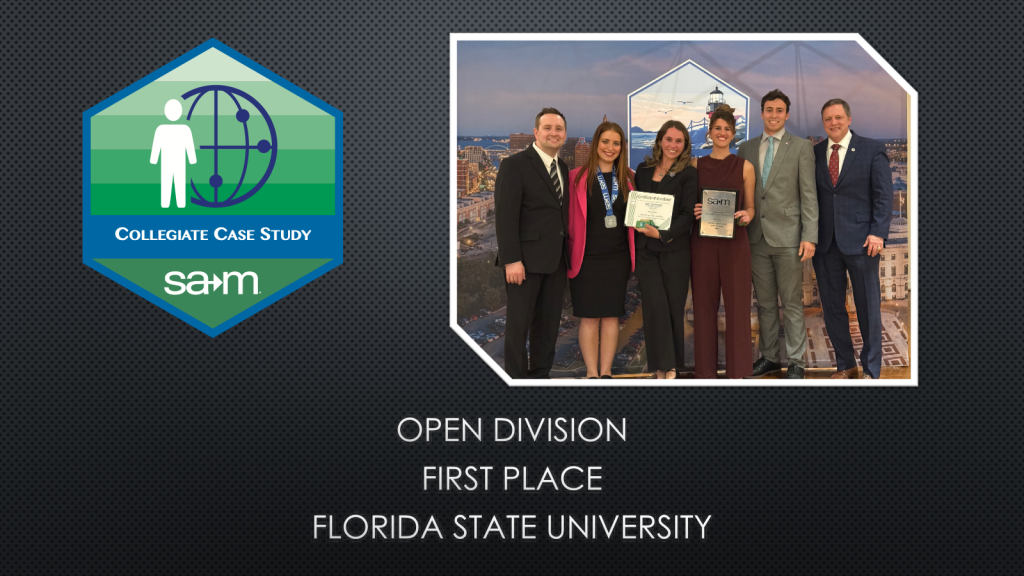
🥇 1st Place — Florida State University
Curtis Austin, Brooke Abbott, Jules Johannemann
🥈 2nd Place — Ohio Northern University
Olivia Bacon, Grant Israel, Emersyn Gerken, Drew Elfers, Kevin Vonderwell
🥉 3rd Place — Stephen F. Austin State University
Lydia Sattler, Zala Ule
What distinguished this division was the depth of thinking and the ability to connect strategy to execution. The top teams demonstrated not only what should be done, but how it could realistically be achieved.
“What impressed us most wasn’t just the quality of the ideas, but how actionable they were,” said Ted Williams, President of Senesco Marine. “Several of the teams presented solutions we’re already exploring for implementation.”
For SAM leadership, this level of performance reflects the purpose of the competition.
“When students are working on real problems for real organizations, the expectations shift,” said Patrick Endicott, Executive Director of SAM. “It’s no longer about theoretical solutions. It’s about making decisions that could actually be implemented.”
The Open Division serves as a capstone experience, demonstrating that these students are not only prepared to analyze complex challenges, but to lead through them.