
Trust is often treated as a universal good in organizations. Leaders are encouraged to build it, teams are expected to rely on it, and cultures are often evaluated by how much of it exists. Yet in complex environments, trust alone is not always enough to ensure effective performance. In some cases, it can even create blind spots that limit awareness and reduce adaptability.
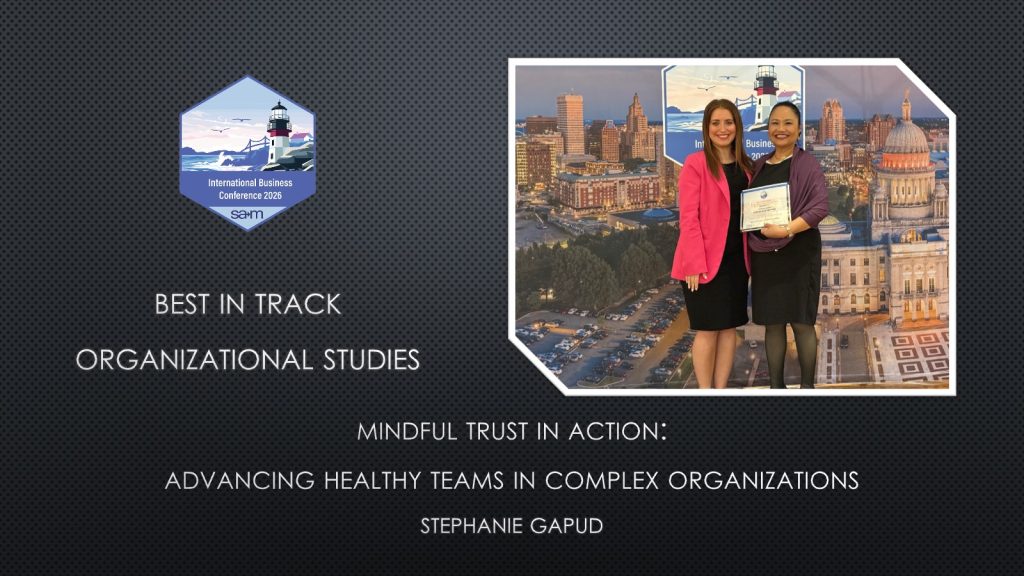
Stephanie Gapud’s research challenges this conventional thinking by offering a more nuanced perspective on how trust actually functions within teams. As the recipient of the Best in Track Award for Organizational Studies, Gapud is recognized for her paper, “Mindful Trust in Action: Advancing Healthy Teams in Complex Organizations.” Her work introduces Mindful Trust Theory, a framework that redefines trust as a dynamic, attention-based process shaped by both relational confidence and cognitive awareness.
At the center of the research is a critical shift in perspective. Rather than viewing trust as a static belief or personality trait, Gapud positions it as an evolving stance that influences how individuals interpret information, respond to uncertainty, and interact with others. This reframing becomes especially important in environments where conditions are constantly changing and decisions must be made with incomplete information.
The research draws on concepts from organizational mindfulness, sensemaking, and dual-process cognition to explain how teams navigate complexity. Mindful trust is defined as “trust with awareness,” a present-focused orientation that balances openness with discernment and allows teams to remain both cohesive and adaptable under pressure.
Through empirical analysis, the study identifies three distinct cognitive-trust profiles that emerge within teams. Mindful Trusters combine high levels of trust with strong attentional awareness, creating an environment where collaboration and vigilance reinforce one another. Mindless Trusters, by contrast, exhibit high trust but lower levels of mindfulness, often relying on authority and established patterns without fully engaging in critical evaluation. Skeptical Mindfuls demonstrate the opposite dynamic, maintaining high levels of awareness while exhibiting lower interpersonal trust, which leads to more cautious and analytical decision-making.
Each of these profiles reveals a different pathway to performance. The findings show that teams with both high trust and high mindfulness tend to achieve the strongest outcomes, as they are able to integrate relational cohesion with disciplined attention. However, the research also highlights that performance is still possible in the absence of trust when mindfulness is strong, suggesting that attentional awareness can compensate for weaker interpersonal dynamics in certain contexts.
This insight challenges one of the most common assumptions in leadership and team development. Trust, while valuable, is not inherently beneficial in all forms. When it exists without mindfulness, it can lead to overconfidence, groupthink, or a lack of critical engagement. Conversely, a more skeptical but attentive approach can enhance accountability and improve decision quality when managed effectively.
The practical implications of this work are significant. Leaders can use these insights to better understand the dynamics within their teams and adjust their approach accordingly. Rather than applying a one-size-fits-all strategy to building trust, they can tailor their leadership style to the specific cognitive and relational profiles present within their organization. This allows for more targeted development, improved communication, and stronger alignment between team behavior and organizational goals.
There is also an important organizational takeaway embedded in the research. High-performing teams are not defined by uniformity, but by their ability to balance different perspectives and approaches to trust and awareness. Recognizing and leveraging this diversity can create more resilient systems that are better equipped to navigate uncertainty and complexity.
The Best in Track Award for Organizational Studies recognizes research that advances both theory and practice. Gapud’s work does exactly that by offering a framework that is both conceptually rigorous and highly applicable. It provides leaders with a new lens through which to view trust, not as a fixed resource to be maximized, but as a capability to be cultivated with intention.
As organizations continue to operate in increasingly complex environments, the ability to trust with awareness may become one of the most important competencies teams can develop. Stephanie Gapud’s research offers a timely reminder that effective leadership is not just about building trust, but about shaping how that trust is understood, applied, and sustained over time.