
There is a moment in every power outage when uncertainty takes over. You look around, wonder how widespread it is, and wait for someone, somewhere, to figure out what went wrong. For decades, that “someone” has depended largely on one thing: the customer picking up the phone.
Cody Cruz saw that gap clearly, and more importantly, saw what could replace it.
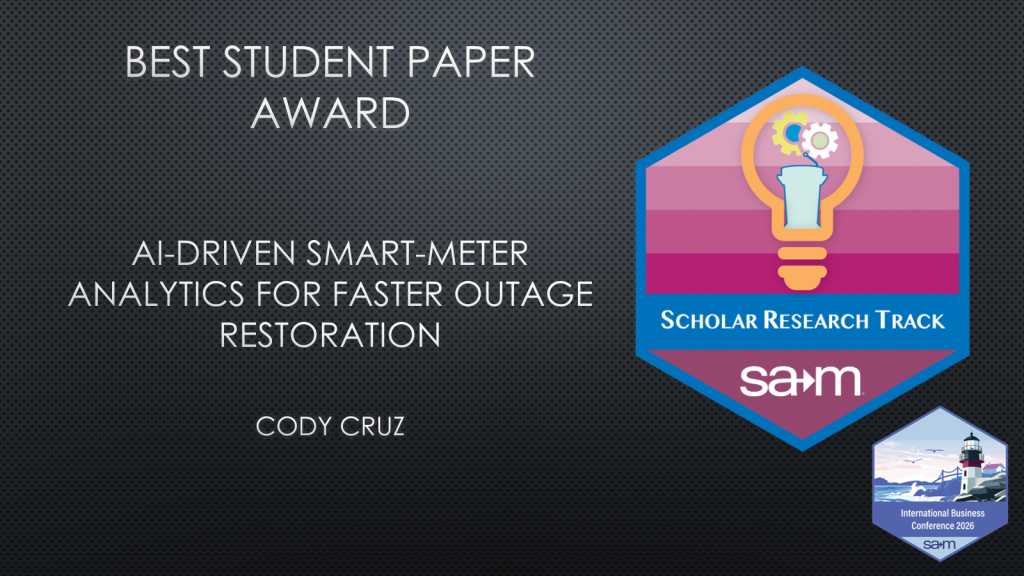
Recognized with the Best Student Paper Award at the SAM International Business Conference, Cruz’s research, “AI-Driven Smart-Meter Analytics for Faster Outage Restoration,” reimagines how electric utilities respond when the lights go out. Instead of relying on delayed, manual reporting, his work points toward a system that already knows there is a problem and where it is happening.
At the center of his approach is something most utilities already have but have not fully leveraged: smart-meter data. These devices constantly generate real-time information about power usage, voltage, and system behavior. When paired with weather data and analyzed through machine learning models, that information becomes more than just a record. It becomes a signal.
Cruz’s research outlines a workflow that transforms that signal into action. Data is collected and processed, analyzed through predictive models, and then fed directly into outage management systems. What traditionally required multiple customer calls and manual verification becomes a streamlined, automated process capable of identifying outages in minutes rather than hours.
The implications are practical and measurable. His model targets a meaningful reduction in outage detection time, faster decision-making for dispatching crews, and a significant improvement in overall workflow efficiency. These are not abstract benefits. They translate directly into shorter outages, more reliable service, and a better experience for customers who often feel the impact of system delays most acutely.
What makes this work stand out is not just the technology. It is the way Cruz connects that technology to real operational challenges. Many utilities already collect vast amounts of data, yet still operate in systems that depend on reactive processes. His research bridges that gap, offering a clear path from data collection to decision-making.
It also acknowledges the realities of implementation. Integrating new analytics into existing systems like outage management platforms, grid control systems, and regulatory frameworks is not simple. Cruz’s work does not ignore those complexities. Instead, it provides a roadmap that aligns technical capability with operational feasibility, showing how innovation can be adopted without disrupting critical infrastructure.
At its core, this research is about shifting perspective. It challenges the idea that outages must be discovered after they happen and instead positions utilities to anticipate and respond with precision. It is a move from reaction to readiness, from delay to insight.
That shift matters. As communities become more dependent on reliable energy and as weather events grow more unpredictable, the ability to respond quickly is no longer a competitive advantage. It is an expectation.
Cody Cruz’s work meets that expectation head-on. It demonstrates what is possible when data, technology, and management thinking come together with a clear purpose. And it reflects exactly what the Best Student Paper Award is meant to recognize: research that does not just describe a problem, but offers a meaningful path forward.