
Historic timber buildings carry more than structural weight. They carry stories of craftsmanship, community, and the evolution of industry across generations. These structures stand as physical connections to the past, yet maintaining them presents a unique challenge that requires both technical precision and thoughtful decision-making.
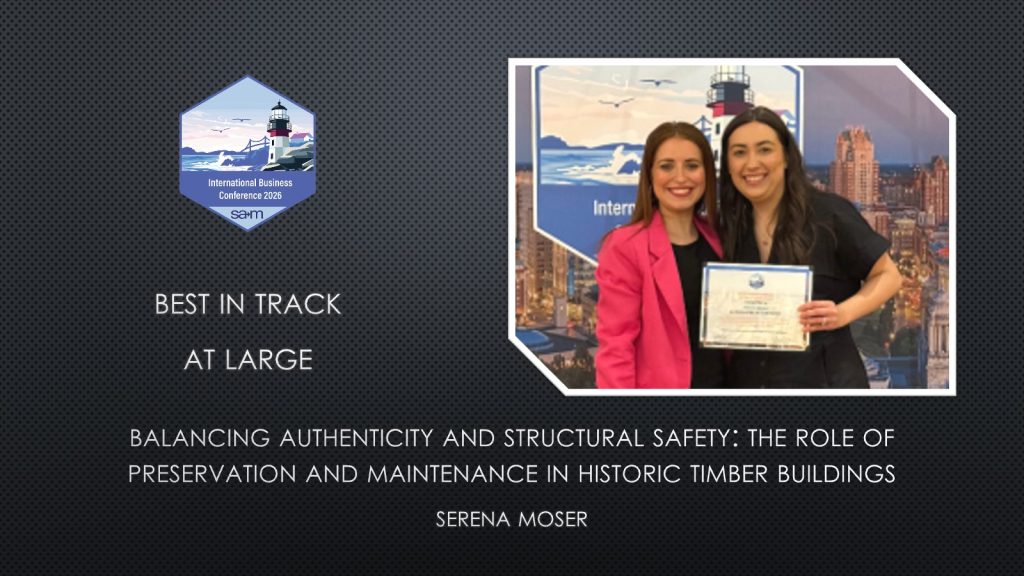
This challenge is at the center of award-winning research by Serena Moser of the New England Institute of Technology, recipient of the Best in Track Award in the At Large category at the 2026 SAM International Business Conference. Her paper, “Balancing Authenticity and Structural Safety: The Role of Preservation and Maintenance in Historic Timber Buildings,” explores how professionals navigate the tension between preserving historical integrity and ensuring modern structural safety.
Timber buildings are inherently vulnerable. Over time, exposure to moisture, insects, and environmental stress can weaken structural elements, creating risks that must be addressed. Yet replacing these materials outright can erase the very features that give these structures their historical and cultural value. This creates a central dilemma: how much intervention is necessary, and at what point does preservation become replacement.
Moser’s research examines this question through a combination of conservation theory, federal preservation standards, and real-world case studies. The findings highlight that preservation is not about freezing a structure in time, but about managing change in a way that respects both its history and its continued use. Decisions must be deliberate, evidence-based, and aligned with clearly defined intervention thresholds.
A key insight from the research is that not all structural issues require full replacement. In many cases, targeted repairs such as localized reinforcement or partial reconstruction can restore functionality while preserving the majority of original material. Techniques such as scarf joints, timber splicing, and selective reinforcement allow engineers to address deterioration without compromising authenticity.
At the same time, the research acknowledges that there are limits to preservation. When structural integrity is significantly compromised, replacement may become necessary to ensure safety and usability. In these cases, the goal shifts to maintaining compatibility and transparency, ensuring that new materials are distinguishable while still respecting the original design.
The study brings these concepts to life through case examples, including historic barns and industrial timber structures across New England. These examples demonstrate how preservation decisions are made in practice, balancing technical requirements with cultural considerations and community value.
What makes this work particularly relevant is its broader implication for management and decision-making. Preservation is not only a technical challenge, but also a leadership challenge. It requires balancing competing priorities, making informed trade-offs, and aligning decisions with long-term outcomes.
This perspective extends beyond historic buildings. Across industries, leaders are often faced with similar decisions where maintaining legacy systems must be weighed against the need for modernization. The ability to navigate these choices effectively determines whether organizations can preserve value while adapting to changing conditions.
The Best in Track Award recognizes research that connects theory with real-world application. Serena Moser’s work exemplifies this by providing a framework that is both technically grounded and practically relevant. It offers a clear approach to making complex decisions in environments where both history and safety matter.
In the end, preserving the past is not about resisting change. It is about managing it with care, intention, and respect. This research reinforces the idea that with the right approach, it is possible to protect both the integrity of historic structures and the safety of those who continue to use them.