
In today’s business environment, data is often described as a company’s most valuable asset. At the same time, Generative AI promises to transform how organizations operate, innovate, and compete. Yet despite these advantages, many data-driven firms are still struggling to deliver meaningful results from their AI investments.
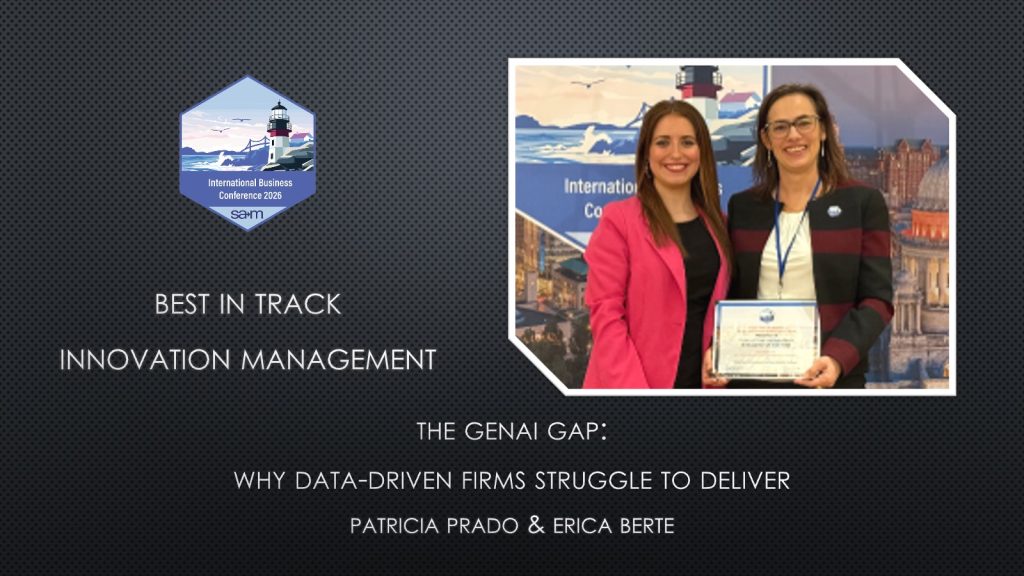
This disconnect sits at the center of award-winning research by Patricia Prado of the University of São Paulo and Erica Berte of Metropolitan State University, recipients of the Best in Track Award for Innovation Management at the 2026 SAM International Business Conference.
Their work explores a fundamental question facing modern organizations. If companies have more data and more powerful tools than ever before, why is value creation still so difficult?
The answer lies not in the technology itself, but in how organizations are structured to use it. Through interviews with senior leaders across major enterprises, the research reveals that many organizations remain caught in a cycle of experimentation. AI initiatives are launched, pilots are tested, and ideas are explored, but few efforts scale into measurable business impact.
A key challenge is the lack of alignment between AI initiatives and broader business strategy. When projects are disconnected from organizational goals, even technically successful implementations fail to deliver meaningful outcomes. At the same time, fragmented data governance and inconsistent data quality create additional barriers, limiting trust in AI-driven insights.
The research also points to a deeper issue: culture. Building a truly data-driven organization requires more than tools and infrastructure. It requires shared understanding, strong leadership, and a commitment to integrating data into everyday decision-making. Without this cultural foundation, even the most advanced AI systems struggle to gain traction.
Another critical factor is data literacy. Organizations often invest heavily in technology but overlook the importance of helping employees understand and use data effectively. When teams lack the ability to interpret insights or ask the right questions, the value of AI initiatives diminishes significantly.
Despite these challenges, the research offers a clear path forward. Organizations that succeed in capturing value from GenAI do so by aligning strategy, strengthening governance, and investing in leadership that bridges the gap between technology and business outcomes. They treat data not just as an asset, but as a capability that must be developed across the entire organization.
Ultimately, this work highlights an important truth about innovation. Technology alone does not create value. It is the combination of strategy, culture, and execution that determines whether organizations can turn potential into performance.
As AI continues to evolve, this insight will only become more important. The companies that close the GenAI gap will not be those with the most data or the most advanced tools, but those that learn how to use them with clarity, alignment, and purpose.