
In modern manufacturing, the ability to track products from start to finish is no longer a luxury. It is a requirement for quality, efficiency, and accountability. As production systems grow more complex, organizations must find better ways to connect data, processes, and performance in real time.
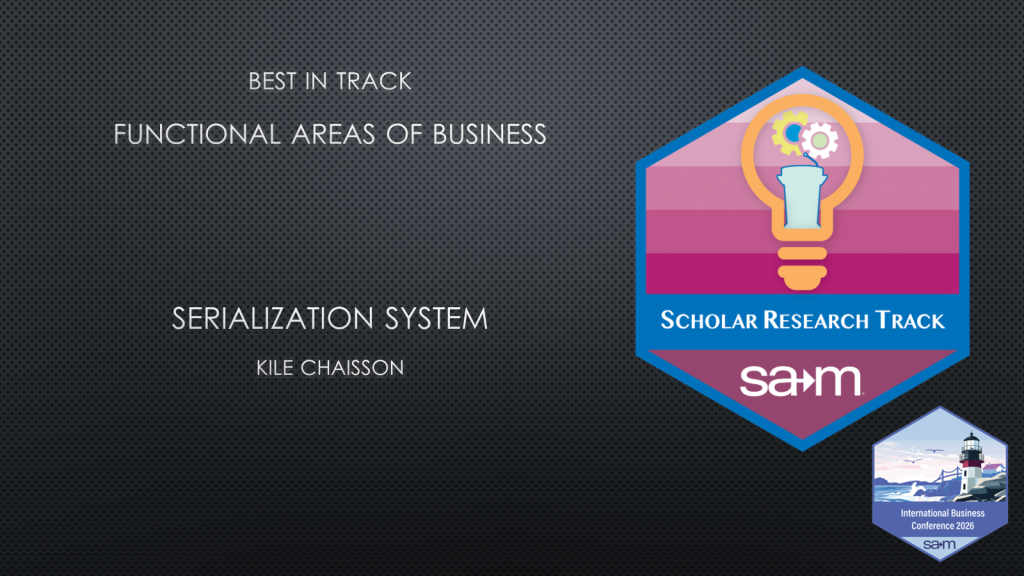
This challenge sits at the center of award-winning work by Kile Chaisson of the New England Institute of Technology, recipient of the Best in Track Award for Functional Areas of Business at the 2026 SAM International Business Conference.
Chaisson’s project focuses on a critical gap in many manufacturing environments: the lack of consistent, end-to-end traceability across the production process. Without reliable tracking, identifying defects, diagnosing issues, and improving performance becomes significantly more difficult.
To address this, the project introduces an automated serialization system designed to mark each product with a unique code and track it throughout every stage of production. Using laser marking technology and machine vision systems, each component is scanned, recorded, and linked to its specific build and testing data.
This creates a digital thread that connects every step of the manufacturing process. Instead of relying on manual tracking or fragmented data systems, organizations gain a clear and immediate view of how each product moves through production and where issues may occur.
The impact of this approach extends beyond visibility. By enabling precise tracking, the system allows organizations to identify defects faster, monitor equipment performance, and reduce scrap. Over time, these improvements contribute to greater efficiency, lower costs, and more consistent product quality.
At the same time, the project highlights the broader complexity of implementing automation in real-world environments. Introducing new systems requires more than technical design. It involves training employees, integrating with existing infrastructure, and ensuring that data is captured and used effectively.
Chaisson’s work reflects this balance between innovation and execution. The system is not just designed to function, but to integrate seamlessly into existing operations while supporting long-term process improvement.
Ultimately, this project demonstrates an important principle in modern management. Technology creates opportunity, but value comes from how that technology is applied. By connecting automation with data-driven decision-making, organizations can move beyond reactive problem-solving and toward proactive performance management.
As manufacturing continues to evolve, solutions like this will play an essential role in building smarter, more responsive production systems.