
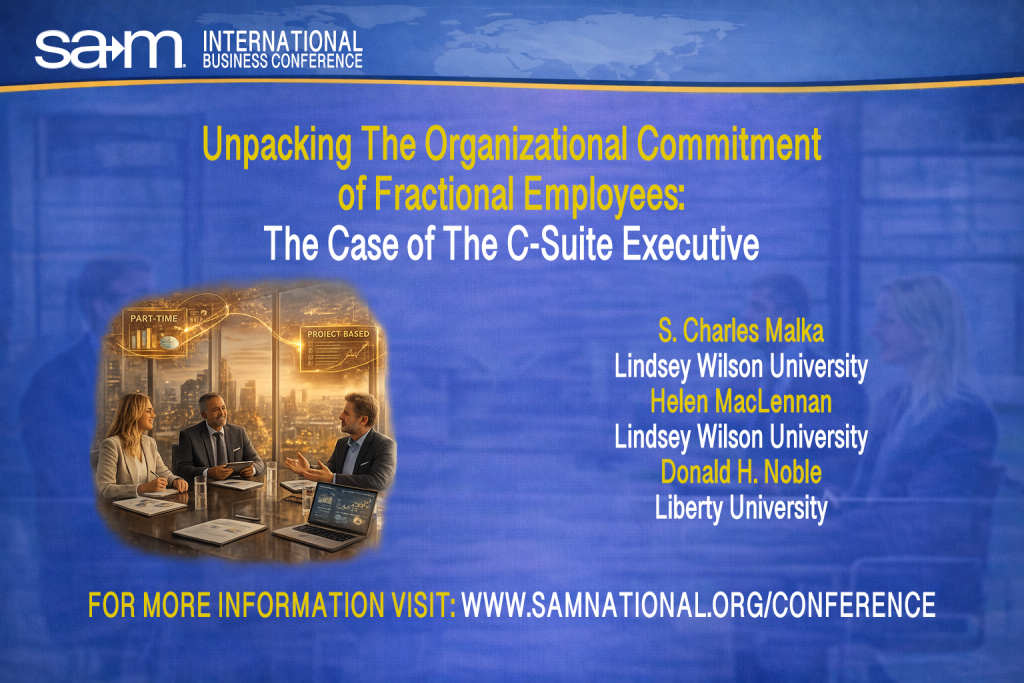
Fractional executives are reshaping the leadership landscape. Serving multiple organizations simultaneously in part-time or project-based C-suite roles, these leaders challenge traditional assumptions about organizational loyalty and long-term commitment. As fractional employment continues to grow, understanding how these executives experience and express commitment becomes increasingly important for organizations seeking high-level strategic talent.
In this virtual presentation within the Organizational Studies track, S. Charles Malka, Helen MacLennan, and Donald H. Noble examine how protean and boundaryless career orientations influence organizational commitment among fractional executives. Drawing on survey data from 169 executives across diverse industries, the study explores how self-directed, values-driven career attitudes intersect with affective, normative, and continuance commitment.
Using Necessary Condition Analysis, the authors find that protean career attitudes are significant predictors of overall organizational commitment, particularly affective commitment. Executives who are guided by personal values and self-direction demonstrate stronger emotional attachment to the organizations they serve. However, these attitudes are not necessary conditions for continuance or normative commitment. Boundaryless career attitudes yield more nuanced results, with mobility preference predicting affective commitment while psychological flexibility shows no significant relationship with other forms of commitment.
These findings advance theoretical understanding of leadership commitment in flexible and nontraditional work arrangements. They also offer practical implications for organizations engaging fractional C-suite leaders. Aligning work design, expectations, and leadership structures with the values and motivations of protean-oriented professionals may enhance commitment and performance within these arrangements.
Authors and Affiliations
S. Charles Malka, Lindsey Wilson University
Helen MacLennan, Lindsey Wilson University
Donald H. Noble, Liberty University
As organizations increasingly rely on flexible executive talent, this research provides timely insight into how career attitudes shape leadership effectiveness and organizational attachment. Learn more about this presentation and register for the SAM International Business Conference at www.samnational.org/conference.