
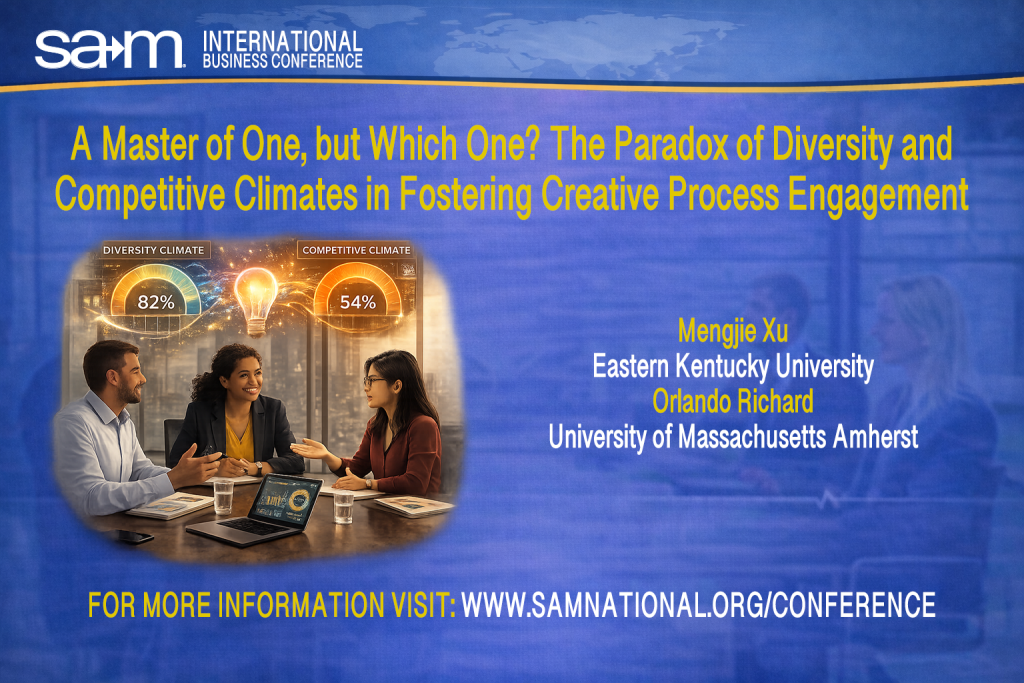
Can organizations be both highly inclusive and intensely competitive at the same time? Many workplaces attempt to signal that diversity, belonging, and inclusion are central values while also promoting strong performance expectations and internal competition. These dual signals may appear contradictory, yet they shape how employees interpret their work environment and decide how much energy to invest in creative efforts.
In this virtual presentation within the Organizational Studies track, Mengjie Xu and Orlando Richard examine how psychological diversity climate and competitive climate jointly influence employee creative process engagement. Drawing on self-determination theory, the research explores how different climate configurations satisfy or frustrate employees’ psychological needs for autonomy and relatedness, ultimately shaping their motivation to engage in creative work.
Across two multi-wave studies conducted in the United Kingdom and the United States, the researchers test how congruence and incongruence between diversity and competitive climates affect creativity. Study 1 reveals that employees are often more creative when one climate is clearly dominant rather than when both climates are aligned at similar levels. High-high congruence produces better outcomes than low-low congruence, but simple alignment is not always the most effective path to fostering creative engagement.
Study 2 replicates these findings and extends them by uncovering a critical asymmetry. The highest levels of creative process engagement occur when organizations prioritize diversity climate over competitive climate. In other words, while competition may drive performance in certain contexts, an inclusive foundation appears to provide the psychological safety and sense of belonging necessary for sustained creative effort.
These findings challenge the assumption that conflicting climates are purely detrimental. Instead, the research suggests that managers must think carefully about which climate to emphasize and how those signals interact. An environment that balances ambition with inclusion may not be as effective as one that clearly anchors its identity in diversity first and competition second.
Authors and Affiliations
Mengjie Xu, Eastern Kentucky University
Orlando Richard, University of Massachusetts Amherst
Designed for scholars and practitioners in organizational behavior and leadership, this session provides actionable insight into managing complex workplace signals. As organizations strive to foster innovation, understanding how diversity and competitive climates intersect is essential for unlocking employee creativity. Learn more about this presentation and register for the SAM International Business Conference at www.samnational.org/conference.