
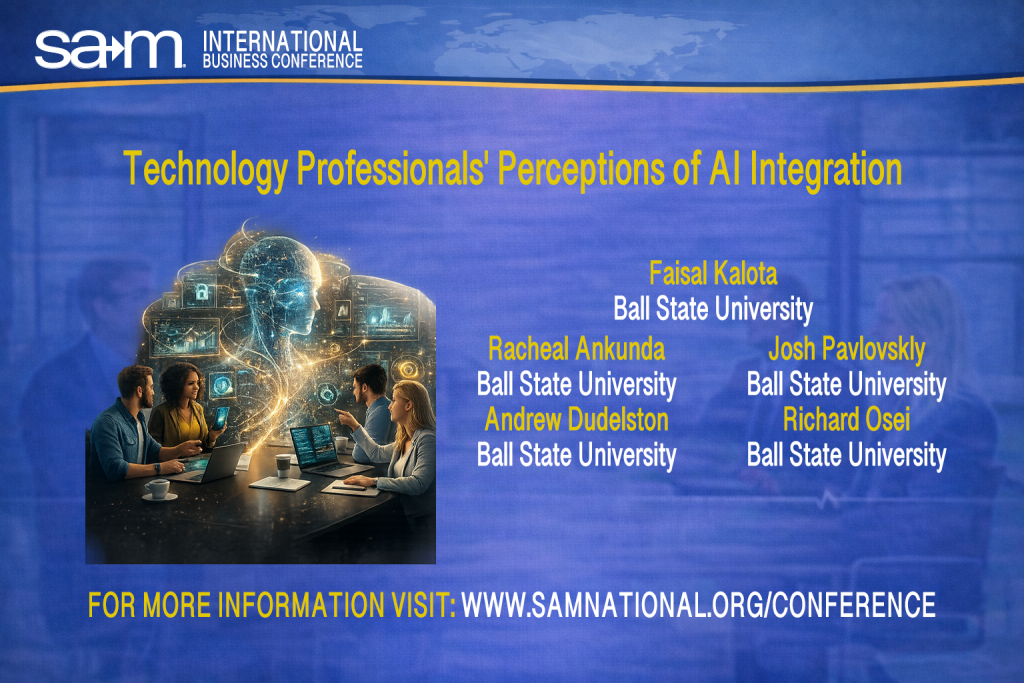
professionals, AI is no longer a future concept but a present reality shaping productivity, task execution, and long term career development. As organizations increasingly integrate AI assisted tools into software development, cybersecurity, and data analytics environments, understanding how professionals perceive this shift becomes essential.
In this virtual presentation within the Career and Professional Development track, Faisal Kalota and colleagues from Ball State University examine how technology professionals perceive AI integration across their work environments. Drawing on mixed methods research with in depth survey responses from software developers, cybersecurity specialists, and data scientists across varying age groups and backgrounds, the study explores both optimism and concern surrounding AI enabled tools.
The findings indicate that most respondents view AI as a reliable and supportive tool for technical tasks. Many professionals report improvements in productivity and efficiency when using AI assisted systems. However, the research also highlights important limitations. Concerns include hallucinated information, data privacy risks, and uncertainty around long term trust in automated outputs. These nuanced perceptions reveal that acceptance of AI is not unconditional but grounded in critical evaluation of reliability and governance.
A significant insight from the study is that 60 percent of respondents believe adaptability and continuous learning are essential for career preparation in an AI integrated environment. Rather than viewing AI as a threat, many professionals recognize the need to evolve their skills to remain competitive and relevant. This aligns with broader workforce development trends emphasizing lifelong learning and digital fluency.
From a career and professional development perspective, the session offers important implications for educators, managers, and career services professionals. As AI tools reshape workflows, organizations must support professionals in developing both technical competency and critical evaluation skills. The discussion also invites reflection on how trust in automation influences decision making, productivity, and professional identity in technology driven environments.
Authors and Affiliations
Faisal Kalota, Ball State University
Racheal Ankunda, Ball State University
Andrew Dudelston, Ball State University
Josh Pavlovsky, Ball State University
Richard Osei, Ball State University
This research provides timely insight into how those closest to AI tools perceive their impact on work and career prospects. If you are navigating AI adoption in your organization or preparing students for technology careers, this session offers evidence based perspective and meaningful discussion. Learn more about this presentation and register for the SAM International Business Conference at www.samnational.org/conference.