
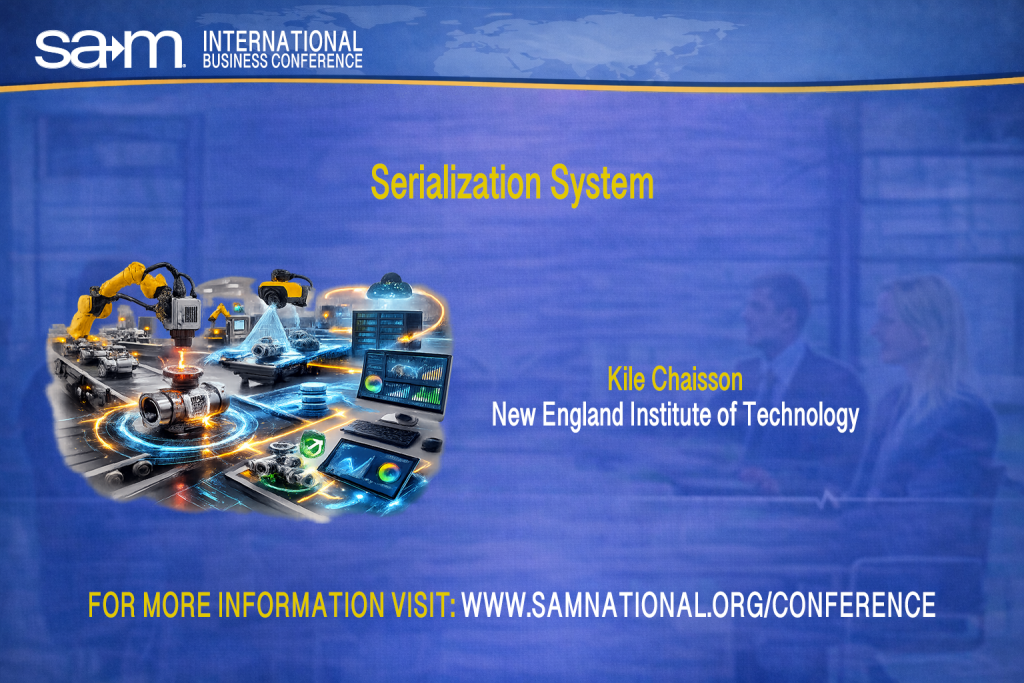
In modern manufacturing, speed alone is no longer a competitive advantage. Precision, traceability, and data integration define operational excellence. As production lines become more automated and product complexity increases, organizations must be able to track every component through each stage of assembly and testing. Without a reliable serialization system, identifying defects, diagnosing machine issues, or validating quality standards becomes time consuming and costly. This student research project addresses that challenge through the design and implementation of an automated valve serialization system.
The project focuses on a new line of very high speed valves and proposes a machine capable of laser marking a unique serial code directly onto each valve body. Every unit receives a distinct identifier that follows it through the entire manufacturing lifecycle. From plunger stuffing and plasma treatment to epoxy processes, cycle testing, and final testing, each stage is digitally recorded. This creates a comprehensive production history linked to both build specifications and testing data.
At the center of the system is automation supported by Cognex camera technology. Before each assembly or testing phase, cameras scan the valve’s serialized code and upload relevant data to the company’s server. This process establishes a digital footprint for every product and connects it to its Automated Test Specification and the specific equipment used during manufacturing. The result is an integrated data stream that improves visibility across the production floor.
The primary objectives of the project include improving quality control, enhancing traceability, increasing production efficiency, and reducing scrap. By assigning serialized codes and capturing real time production data, the company gains the ability to identify trends related to equipment performance, testing anomalies, or process variation. Instead of manually searching for the root cause of a defect, engineers can analyze data linked to individual valves and pinpoint issues more quickly.
Beyond quality assurance, the system supports compliance with evolving manufacturing standards. Serialization is increasingly expected across industries as a foundation for accountability and continuous improvement. Implementing such a system positions the organization to meet customer expectations while strengthening long term operational resilience. It also establishes a scalable framework that can support additional product lines and future automation initiatives.
The presentation integrates project management principles, systems engineering methodologies, and data driven analysis. Scheduling, cost considerations, and risk management are addressed alongside technical integration of laser marking and machine vision systems. By combining operational strategy with technical execution, the project demonstrates how automation and serialization can deliver measurable return on investment while reinforcing a culture of quality.
For manufacturing leaders and operations professionals, this session highlights the strategic importance of traceability in high precision production environments. Serialization is not merely a labeling function. It is a foundational element of modern manufacturing intelligence, linking physical products to digital systems in ways that enable faster decision making and continuous improvement.
Author and Affiliation
Kile Chaisson, New England Institute of Technology
This presentation will be delivered in person at the SAM International Business Conference as part of the Sector Specific Management track. Attendees will explore how automated serialization systems enhance traceability, improve quality control, and support data driven manufacturing environments. For more information visit www.samnational.org/conference