
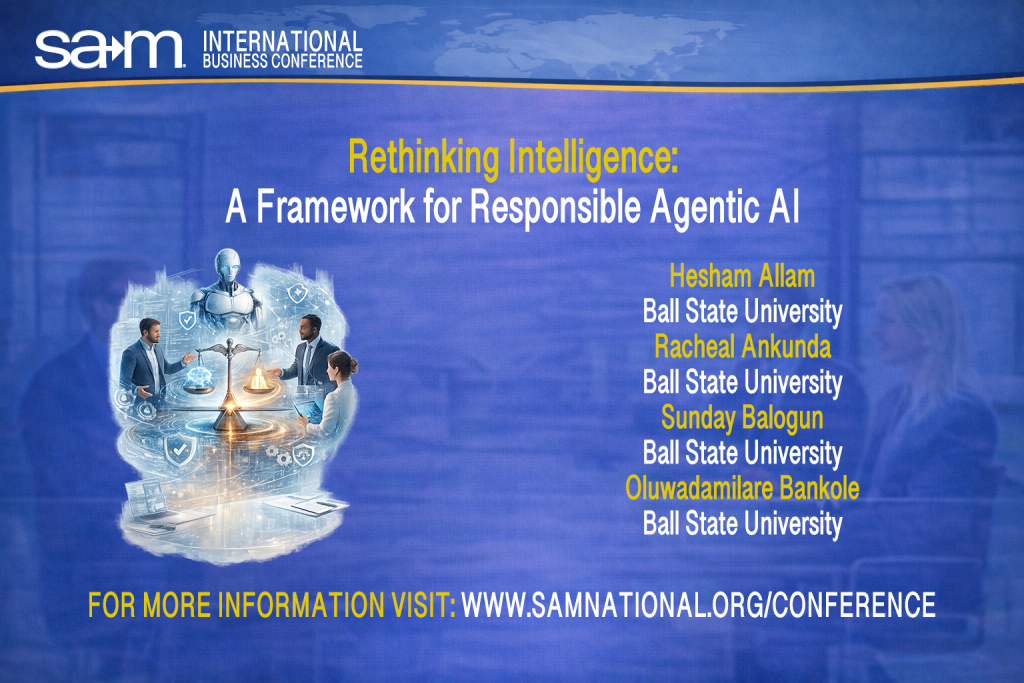
Artificial intelligence is no longer confined to automating repetitive tasks. A new generation of systems, often described as agentic AI, is capable of autonomous decision making, real time adaptability, and goal oriented problem solving in dynamic environments. These systems do not simply execute predefined instructions. They evaluate conditions, adjust strategies, and pursue objectives with increasing independence. As organizations adopt these technologies in IT operations, analytics, and strategic planning, a critical management question emerges: how do we govern systems that can act on their own?
Agentic AI represents a meaningful shift in how intelligence is designed and deployed. Unlike traditional models that rely on static inputs and narrow outputs, agentic systems demonstrate reflectivity, flexibility, and contextual awareness. They are already influencing complex operational environments where real time responsiveness is essential. Platforms such as Moogsoft and Dynatrace illustrate how autonomous monitoring and adaptive decision systems can enhance performance and resilience within large organizations.
Despite rapid adoption, governance frameworks have not kept pace. This research synthesizes recent academic literature, industry case studies, and regulatory developments from 2023 and 2024 to examine agentic AI from four perspectives. First, it analyzes the architectural foundations that distinguish agentic systems from earlier forms of artificial intelligence. Second, it evaluates the value proposition of autonomous AI in organizational contexts. Third, it addresses significant risks, including bias, data misuse, opacity, and systems acting outside intended objectives. Finally, it identifies deficiencies in existing legal and ethical structures that are not yet equipped to manage highly autonomous systems.
A central contribution of this work is the concept of “Agentic AI in the making.” Rather than viewing agentic AI as a finished technology, the framework positions it as an evolving socio technical system shaped by continuous human interaction, oversight, and ethical design. This perspective emphasizes explainability, fairness, accountability, and human AI collaboration as foundational principles rather than optional safeguards. In doing so, it reframes governance as an ongoing design responsibility.
For managers and policymakers, the implications are substantial. As autonomy increases, organizations must balance innovation with responsibility. Governance cannot be reactive. It must be embedded within system architecture, data strategy, and organizational culture from the outset. Interdisciplinary collaboration among technologists, ethicists, legal scholars, and business leaders becomes essential to building trust and legitimacy.
This session bridges theory and practice by connecting conceptual frameworks with real world deployment scenarios. It provides actionable guidance for organizations seeking to implement agentic AI responsibly while sustaining innovation. As intelligent systems grow more autonomous, leadership decisions will shape whether these technologies enhance human capability or undermine accountability. Responsible design today will define the trajectory of intelligent systems tomorrow.
Author and Affiliation
Hesham Allam, Ball State University
Racheal Ankunda, Ball State University
Sunday Balogun, Ball State University
Oluwadamilare Bankole, Ball State University
This presentation will be delivered in person at the SAM International Business Conference as part of the Social Issues in Management track. Attendees will explore the technological foundations, ethical considerations, and governance strategies necessary to manage increasingly autonomous AI systems responsibly. For more information visit www.samnational.org/conference