
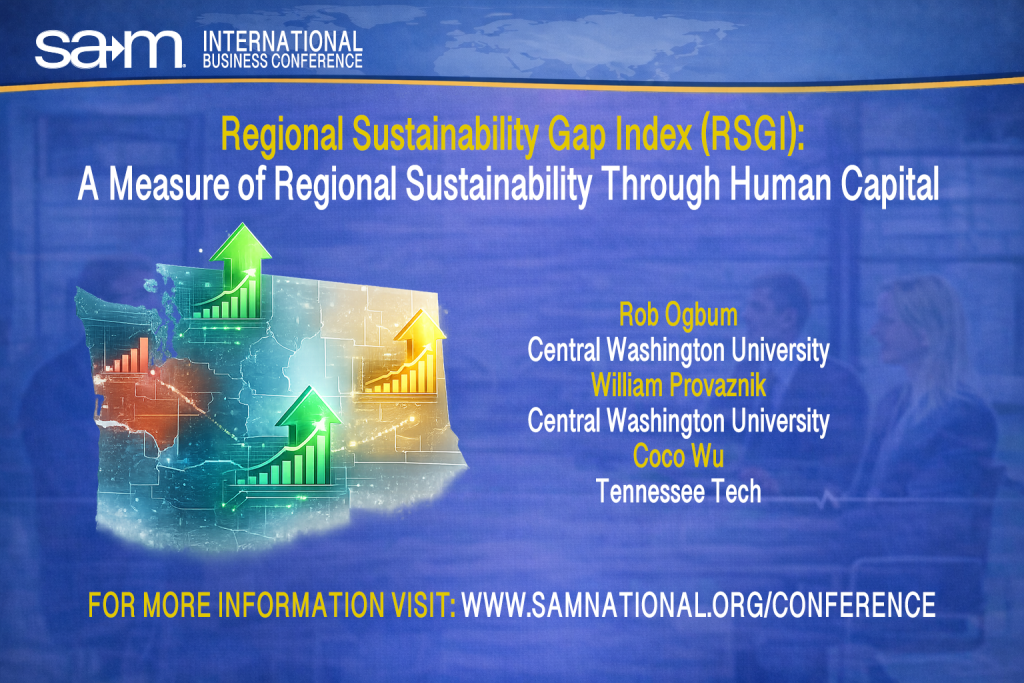
State level economic indicators often tell a story of growth and stability. Gross domestic product rises, employment numbers expand, and investment flows increase. Yet beneath these statewide averages, many counties experience stagnant wages, limited opportunity, and gradual erosion of long term economic viability. Traditional metrics capture scale, but they rarely reveal whether residents can sustain prosperous lives within their home communities. This scholarly research presentation introduces a practical tool designed to close that gap.
The Regional Sustainability Gap Index, or RSGI, provides a wage based framework for evaluating whether a county is on a sustainable long term trajectory relative to its state’s economic frontier. The index combines two core dimensions. The first is the metropolitan wage ratio, which measures a county’s current wage altitude compared to the leading wage region in the state. The second is the relative wage growth ratio, which assesses whether the county is converging toward or diverging from that frontier over time. Together, these measures reveal both present purchasing power and future opportunity.
Plotting counties within the combined wage altitude and wage momentum framework produces four intuitive categories: accelerating, catching up, drifting, or structurally declining. This structure offers policymakers and regional leaders an accessible diagnostic tool. Rather than relying solely on job counts or short term growth signals, the RSGI focuses on wage trajectories that shape migration decisions, educational aspirations, and workforce retention.
Using Washington State’s thirty nine counties as a demonstration case, the research shows how many rural and non metropolitan regions fall into the low wage, low growth quadrant. In these counties, wage horizons narrow over time, signaling long run erosion of opportunity structures. The example of Adams County illustrates how divergence from the state’s wage frontier translates into tangible consequences, including substantial lifetime earnings losses for young residents if corrective strategies are delayed.
From a strategic economic development perspective, the RSGI provides an early warning system. Leaders can identify divergence before it becomes entrenched, align workforce development initiatives with wage improvement strategies, and evaluate whether economic development projects meaningfully shift long term wage paths. The index also supports differentiated policy approaches by recognizing that not all regions possess equal capacity to self correct.
The broader contribution lies in reframing sustainability through a human capital lens. Regional competitiveness is not simply about attracting firms or increasing output. It is about sustaining opportunity structures that allow residents to build stable, upwardly mobile lives. By focusing on wage altitude and wage momentum, the RSGI connects economic metrics to lived experience.
Designed for scholars, policymakers, consultants, and regional development professionals, this session provides a replicable framework that can be adapted across states and regions. It offers a clear, transparent, and data driven approach to measuring long run regional sustainability.
Author and Affiliation
Rob Ogburn, Central Washington University
William Provaznik, Central Washington University
Coco Wu, Tennessee Tech
This academic presentation will be delivered virtually at the SAM International Business Conference within the At Large track. Attendees will gain insight into how wage based sustainability metrics can inform strategic economic development and long term human capital planning. For more information visit www.samnational.org/conference