
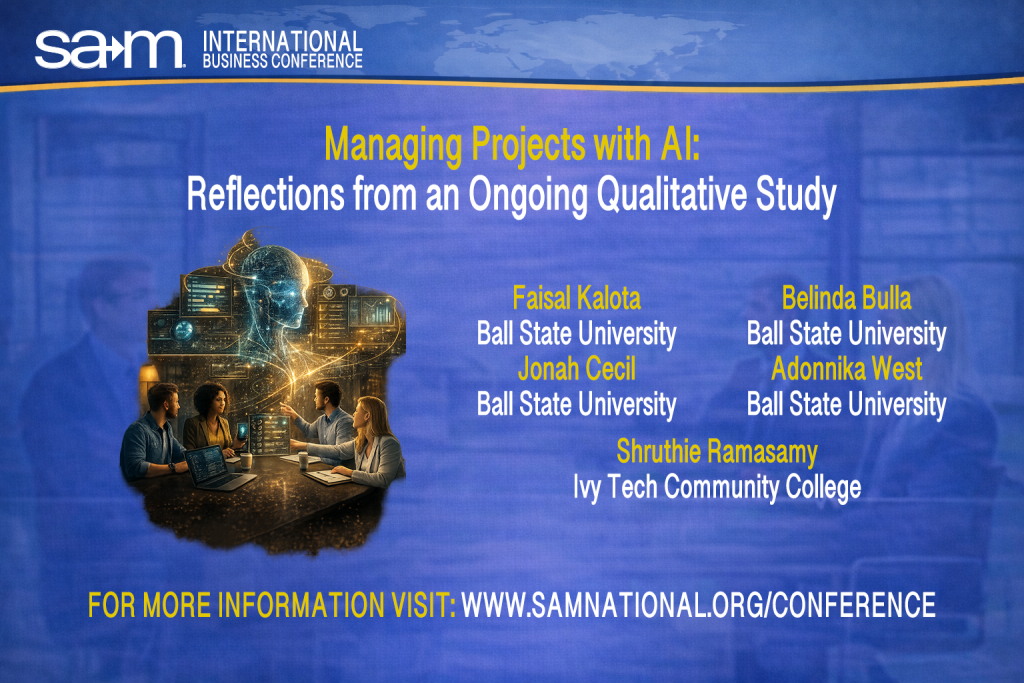
Artificial intelligence is increasingly embedded in business workflows, and project management is no exception. From predictive scheduling and resource allocation to risk assessment and reporting automation, AI tools promise greater efficiency and enhanced decision support. Yet alongside these benefits, project managers are navigating new uncertainties about accountability, oversight, and professional judgment.
In this virtual presentation within the Information Systems and Operations Management track, Faisal Kalota and colleagues share preliminary findings from an IRB-approved qualitative study exploring project managers’ perspectives on AI integration in project-based environments. The research draws on in-depth insights from practitioners who are actively engaging with AI-enabled tools in their daily management responsibilities.
Early findings reveal a dual narrative. On one hand, participants report that AI enhances efficiency, improves data analysis capabilities, and supports faster decision making. Automated reporting, predictive analytics, and workflow optimization are viewed as meaningful advantages that reduce administrative burden and enable more strategic focus. On the other hand, managers express concern about overreliance on automated recommendations and the potential erosion of professional judgment.
A central theme emerging from the study is the continued importance of human oversight. While AI can assist with forecasting, risk modeling, and scheduling, respondents emphasize that final decisions must remain grounded in contextual awareness, stakeholder communication, and ethical consideration. AI is seen as a support mechanism rather than a replacement for managerial expertise.
The findings also highlight organizational challenges, including training gaps, trust in AI outputs, and the need for clear governance structures. As AI becomes embedded in project management software and enterprise systems, organizations must define boundaries for automation and clarify accountability in AI-supported decisions.
Authors and Affiliations
Faisal Kalota, Ball State University
Jonah Cecil, Ball State University
Belinda Bulla, Ball State University
Adonnika West, Ball State University
Shruthie Ramasamy, Ivy Tech Community College
This session offers timely insight for researchers, faculty, and practitioners interested in the evolving relationship between technology and managerial control. As AI adoption expands across project-based industries, understanding how managers perceive its role is essential for designing responsible and effective implementation strategies. Learn more about this presentation and register for the SAM International Business Conference at www.samnational.org/conference.