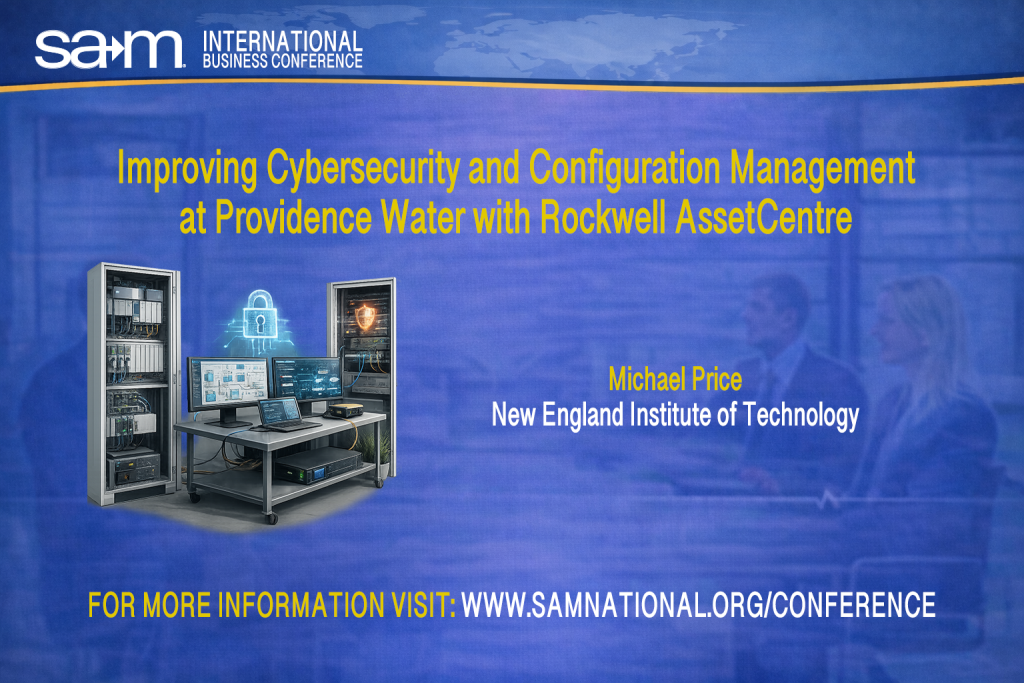
Critical infrastructure depends on systems that must operate continuously, securely, and predictably. Municipal water utilities rely on distributed programmable logic controllers, human machine interfaces, and Supervisory Control and Data Acquisition networks to manage treatment, storage, and distribution. These industrial control systems are foundational to public health and safety. Yet many utilities continue to rely on manual documentation, inconsistent version control, and aging hardware that increase operational and cybersecurity risk. This student research project evaluates how centralized configuration management can strengthen governance and resilience within a municipal water utility environment.
The capstone focuses on Providence Water’s current industrial control systems and SCADA infrastructure. Like many utilities, the organization faces challenges associated with legacy hardware, fragmented documentation practices, and limited configuration oversight. Inconsistent backup procedures and version tracking create exposure to downtime, recovery delays, and cyber vulnerabilities. The project examines whether implementing Rockwell Automation’s AssetCentre platform can provide structured governance, automated backups, and improved configuration control aligned with NIST cybersecurity guidance.
The research outlines four primary objectives. First, it assesses the existing ICS and SCADA asset landscape through structured documentation and verification. Second, it designs a centralized backup and configuration management workflow to standardize version control and restore procedures. Third, it evaluates conceptual integration opportunities with existing OT security platforms, including Tenable OT and Dragon. Finally, it produces a phased implementation roadmap detailing hardware, software, staffing, sequencing, and governance requirements.
Rather than executing live deployment, the project emphasizes structured planning and feasibility analysis. All work is conducted using anonymized or non production data to satisfy cybersecurity and legal constraints. Special consideration is given to compatibility limitations, including aging PanelView 6 human machine interfaces that present modernization challenges. The result is a practical, resource based framework that leadership can use to guide future implementation.
Expected outcomes include a validated asset inventory, a standardized backup and restore procedure, a cybersecurity integration feasibility summary, and a comprehensive rollout roadmap. Together, these deliverables support improved documentation discipline, stronger governance, and enhanced operational continuity. By centralizing configuration oversight, utilities can reduce exposure to configuration drift, accidental changes, and cyber threats.
For engineering managers and infrastructure leaders, this session highlights the strategic value of configuration management in operational technology environments. Cybersecurity in critical infrastructure is not only a technical issue but also a governance and management challenge. Structured documentation, disciplined version control, and automated backups represent foundational elements of resilient modernization.
Author and Affiliation
Michael Price, New England Institute of Technology
This presentation will be delivered in person at the SAM International Business Conference as part of the Invitation Only Submissions track. Attendees will explore how centralized configuration management planning can strengthen cybersecurity governance and operational resilience within municipal water utilities. For more information visit www.samnational.org/conference