
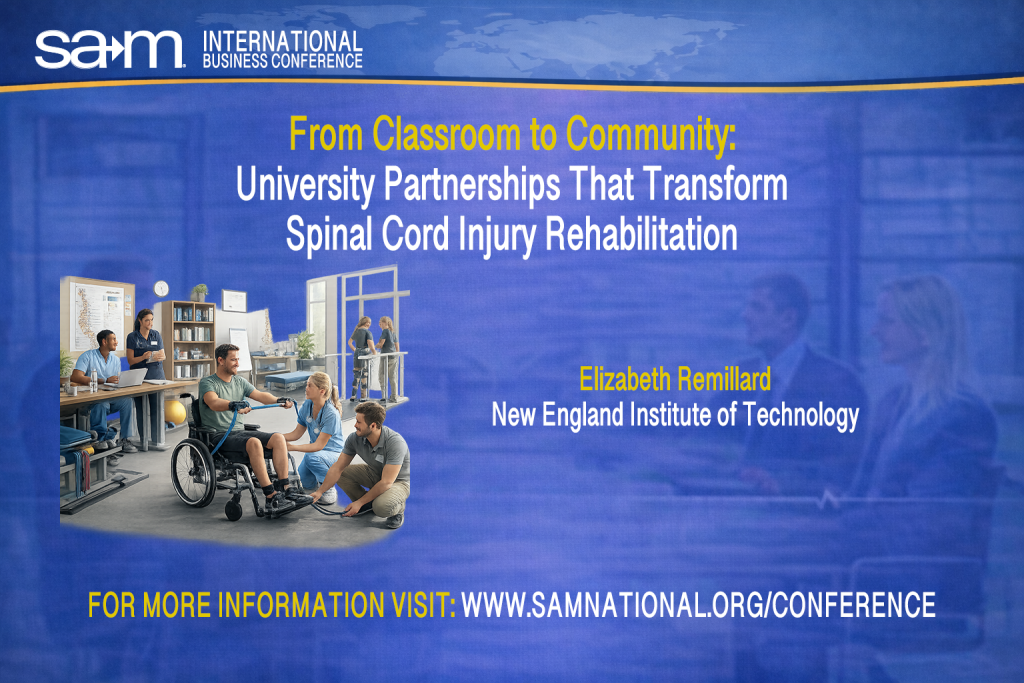
Rehabilitation for individuals living with spinal cord injury requires more than episodic clinical intervention. It demands sustained, community centered support that addresses physical recovery, emotional resilience, leadership development, and long term quality of life. At the same time, healthcare education faces increasing pressure to prepare graduates who are both technically competent and deeply grounded in human centered care. This practitioner research session introduces a partnership model that bridges these needs through intentional collaboration between universities and a community based rehabilitation organization.
Using Empower Spinal Cord Injury as a case example, the presentation explores how academic partnerships can extend beyond traditional clinical placements. Rather than positioning students as observers within fixed rotations, this model integrates occupational therapy, physical therapy, healthcare leadership, and related disciplines into immersive, real world programming. Students and faculty actively engage alongside individuals with spinal cord injury in rehabilitation, leadership development, program design, and evaluation.
The result is a model that strengthens both service delivery and workforce development. Participants with spinal cord injury gain access to expanded programming and increased engagement opportunities. Students benefit from authentic learning environments that emphasize autonomy, lived experience, and long term rehabilitation goals. Faculty contribute expertise in assessment, quality improvement, and innovation. Together, these stakeholders form a collaborative ecosystem centered on shared mission and measurable outcomes.
From a healthcare management perspective, the partnership demonstrates strategic alignment of mission, operations, and sustainability. Shared resources and clearly defined roles allow organizations to expand service capacity without overburdening staff. Shared ownership reduces burnout by distributing responsibility across academic and community partners. Universities become innovation collaborators who support outcome measurement, program development, and continuous improvement rather than serving solely as training sites.
Operational considerations are addressed through structured onboarding, supervision frameworks, risk management protocols, and scope definition agreements. Relationship development and mutual value creation remain central to maintaining long term collaboration. The session provides practical insight into how these elements combine to produce improved participant satisfaction, stronger academic clinical relationships, and a sustainable pipeline of prepared healthcare professionals.
The broader implications extend across public health and nonprofit healthcare management. As workforce shortages intensify and patient needs grow more complex, partnership driven models offer scalable pathways for innovation. By reframing universities as collaborators embedded within community mission rather than external consumers of clinical hours, healthcare organizations can cultivate resilience, adaptability, and shared impact.
Designed for healthcare administrators, rehabilitation leaders, educators, and nonprofit executives, this session offers a replicable framework for building university partnerships that educate, empower, and transform rehabilitation services for individuals living with spinal cord injury.
Author and Affiliation
Elizabeth Remillard, New England Institute of Technology and Empower Spinal Cord Injury
This workshop session will be delivered in person at the SAM International Business Conference within the Public Health and Healthcare Management track. Attendees will gain actionable strategies for building mission aligned academic partnerships that strengthen rehabilitation outcomes and workforce development. For more information visit www.samnational.org/conference