
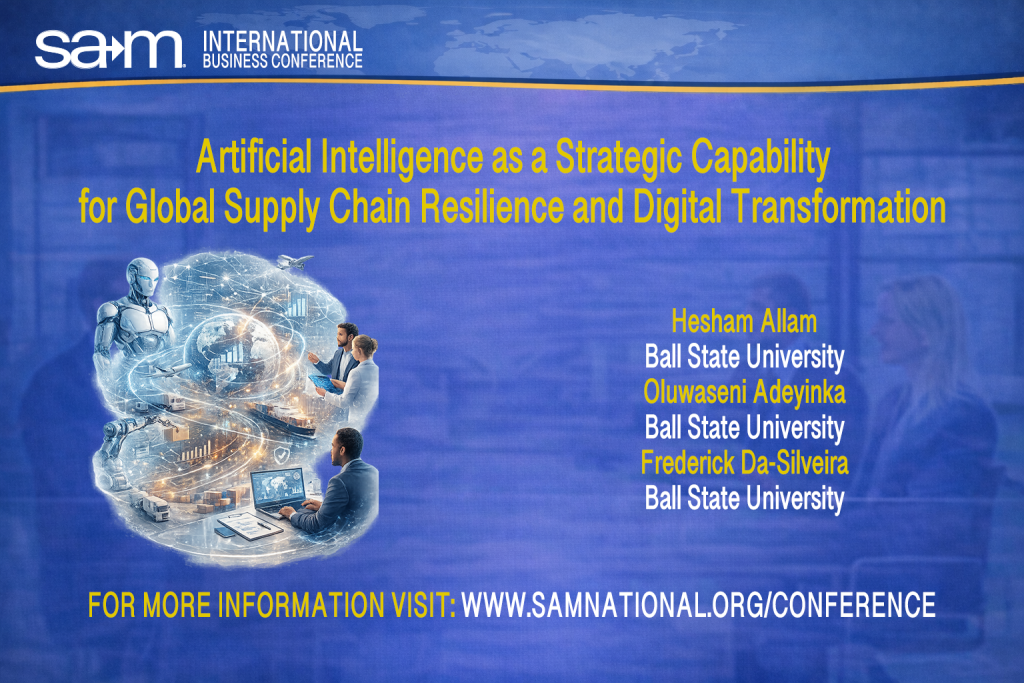
Global supply chains are no longer linear systems designed primarily for efficiency. They have evolved into interconnected networks operating under constant volatility. Geopolitical instability, climate disruptions, pandemics, and rapidly shifting consumer demand have exposed the limitations of traditional supply chain models. What once prioritized cost minimization now demands resilience, visibility, and adaptability. In this environment, artificial intelligence is emerging not simply as a technical tool, but as a strategic capability.
This research reframes artificial intelligence within global supply chain management through the lens of the Resource Based View and Dynamic Capability Theory. Rather than viewing AI as an isolated technology, the study positions it as an organizational capability that enhances sensing, learning, and reconfiguration in dynamic markets. When integrated effectively, AI strengthens a firm’s ability to anticipate disruptions, adapt operations, and respond proactively to uncertainty.
The session synthesizes recent academic research and empirical studies to examine how AI driven analytics, demand forecasting models, and disruption prediction systems improve operational performance. Predictive analytics enhances visibility across sourcing, production, logistics, and distribution. Advanced forecasting tools support decision making under uncertainty, while scenario planning models enable organizations to test strategic responses before disruptions escalate. These capabilities move supply chains from reactive models toward intelligence driven systems that continuously learn and adjust.
However, the adoption of artificial intelligence also introduces structural and ethical challenges. Data quality limitations, high implementation costs, and algorithmic opacity can undermine trust and effectiveness. Small and medium sized enterprises often face unequal access to advanced AI capabilities, raising questions about digital inequality within global supply networks. The presentation emphasizes that resilience must be paired with responsible governance to ensure that AI driven transformation remains sustainable and inclusive.
A central theme of the session is human AI collaboration. While automation enhances speed and scale, strategic judgment remains essential in complex operational contexts. Explainable AI frameworks help build managerial trust by clarifying how decisions are generated. Integrating data governance, personnel development, and ethical oversight into AI initiatives strengthens organizational alignment and long term adaptability.
For academics, practitioners, and policymakers, this session positions artificial intelligence as a core strategic asset rather than a peripheral innovation. The transition from efficiency oriented supply chains to resilient, adaptive networks requires coordinated investment in technology, governance, and capability development. By embedding AI within strategic processes, organizations can strengthen supply chain resilience while advancing responsible digital transformation.
Author and Affiliation
Hesham Allam, Ball State University
Oluwaseni Adeyinka, Ball State University
Frederick Da-Silveira, Ball State University
This presentation will be delivered in person at the SAM International Business Conference as part of the Information Systems and Operations Management track. Attendees will explore how artificial intelligence can be leveraged as a strategic organizational capability to strengthen global supply chain resilience while supporting ethical and sustainable digital transformation. For more information visit www.samnational.org/conference