
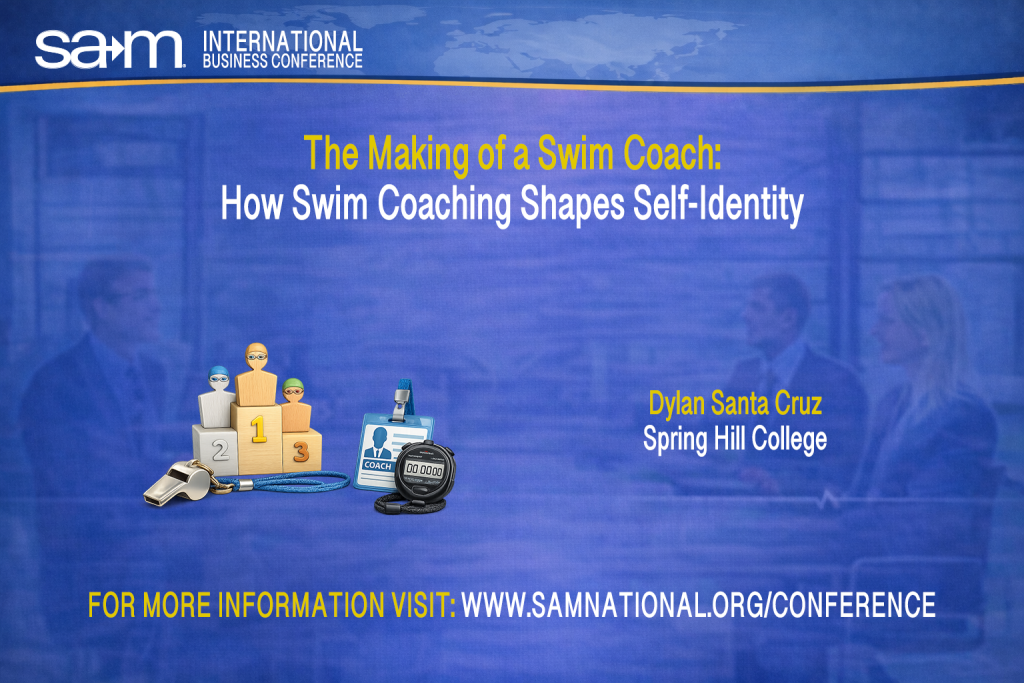
Leadership is not only about influencing others. It is also about how roles reshape the person who steps into them. Coaching, in particular, occupies a unique space where personal, social, and professional identities intersect in powerful ways. This accepted student research presentation explores how swim coaching shapes self-identity over time and what that reveals about identity formation in leadership roles.
Drawing on in-depth interviews with twelve swim coaches from accredited programs, the study examines how coaches describe their evolving identities across personal, social, professional, and coaching domains. Rather than viewing coaching as a simple job function, the research positions it as a dynamic identity process shaped by relationships, feedback, purpose, and values. Coaches consistently described their relationships with athletes and colleagues as the foundation of identity growth, reinforcing the idea that leadership identity is socially constructed rather than individually declared.
The study is grounded in Goffman’s Self-Theory and Self-Determination Theory, providing a framework for understanding how individuals manage multiple identities while striving to meet core psychological needs such as competence, autonomy, and relatedness. Swim coaches frequently navigate role conflicts, public expectations, and internal self-doubt, including experiences related to imposter syndrome. Over time, they learn to adapt their public and private identities depending on context, audience, and performance pressures.
One of the most compelling insights from the research is the role of continuous learning and feedback in shaping coaching identity. Coaches described growth not as a linear progression but as an ongoing negotiation between personal values, team culture, and performance outcomes. Identity development emerged as both reflective and relational, reinforcing that effective leadership requires adaptability and self-awareness.
While focused on swim coaching, the implications extend far beyond athletics. Managers, educators, and organizational leaders also navigate overlapping identities and role expectations. Understanding how identity forms and evolves can help organizations better support leaders, reduce burnout, and foster environments that encourage authentic development. By recognizing that identity is shaped through interaction, feedback, and purpose, organizations can intentionally cultivate healthier leadership pathways.
Designed for scholars and practitioners interested in organization development and identity formation, this in-person presentation invites attendees to reconsider how leadership roles influence the leader. It highlights that developing effective leaders requires attention not only to skill development, but also to the identity work that unfolds behind the scenes.
Author and Affiliation
Dylan Santa Cruz, Spring Hill College
This presentation will be delivered in person at the SAM International Business Conference and contributes to broader conversations about identity, leadership development, and the human dimensions of organizational life. For more information visit www.samnational.org/conference