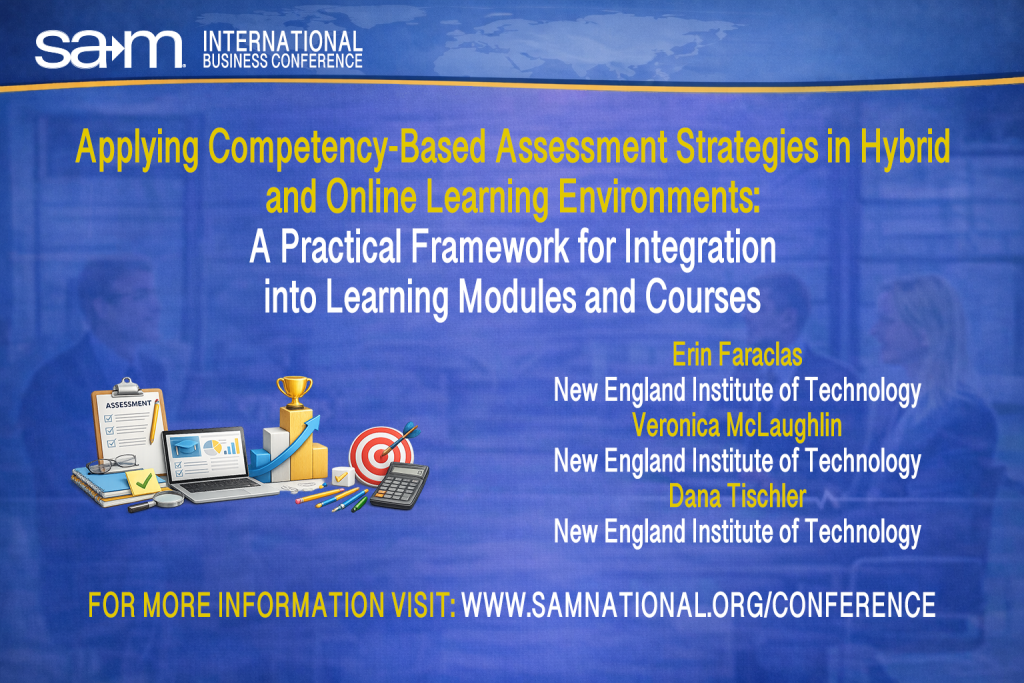
Competency-Based Education is often described as transformative, but for many institutions the concept feels overwhelming. Leaders and faculty may assume that adopting CBE requires a complete institutional overhaul. This accepted presentation challenges that assumption by demonstrating how competency-based assessment strategies can be selectively integrated into hybrid and online learning environments without dismantling existing systems.
Drawing on research and applied experience, the study explores how mastery-based progression, learner-centered pacing, and clearly articulated competency outcomes can be embedded at the course or program level. Rather than treating time as the constant and learning as variable, competency-based approaches reverse the equation. Performance becomes the constant, while time and pacing adjust to support true mastery. In hybrid and online settings, where flexibility is already built into delivery, this shift becomes both practical and powerful.
The framework presented moves beyond theory to application. Faculty can incorporate retake opportunities, low-stakes formative assessments, and transparent competency benchmarks within traditional semester structures. Programs do not need to abandon time-bound calendars to embrace mastery. Instead, they can redesign modules to ensure students demonstrate competence before progressing, strengthening both rigor and fairness in evaluation.
Real-world implementation within a hybrid, accelerated PTA-to-Doctor of Physical Therapy bridge program at New England Institute of Technology provides early evidence of impact. Students reported that flexible timelines, opportunities for reassessment, and clear competency expectations created a more supportive and equitable learning experience. Faculty described an adjustment period that ultimately fostered stronger communication and collaboration, reinforcing that cultural change accompanies assessment redesign.
The implications extend beyond higher education. Competency-informed assessment models offer valuable insight for professional training and organizational development programs. Adult learners, who often bring varied experience and competing responsibilities, benefit from systems that meet them where they are while holding performance standards constant. By guiding both advanced learners and those needing additional time toward mastery, organizations can improve both efficiency and equity.
Designed for educators, administrators, and organizational leaders, this in-person presentation offers a practical roadmap for integrating competency-based strategies into hybrid and online learning environments. It invites attendees to reconsider assessment not as a compliance exercise, but as a strategic lever for organizational health and performance excellence.
Authors and Affiliations
Erin Faraclas, New England Institute of Technology
Veronica McLaughlin, New England Institute of Technology
Dana Tischler, New England Institute of Technology
This presentation will be delivered in person at the SAM International Business Conference and contributes to broader conversations about assessment design, equity in education, and the strategic alignment of learning systems with real performance outcomes. For more information visit www.samnational.org/conference