
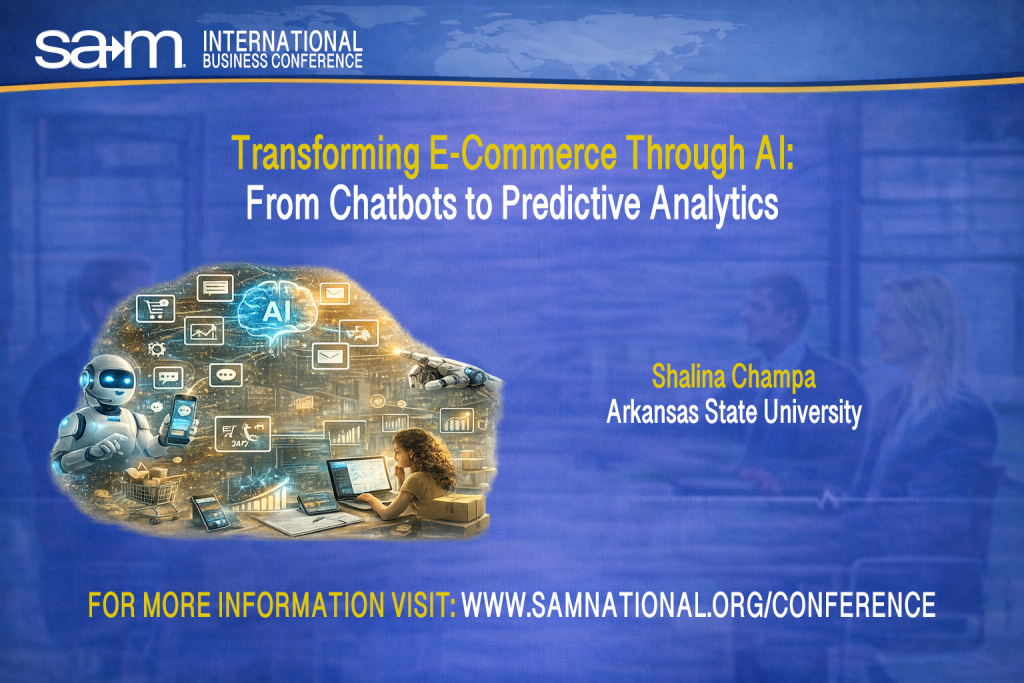
Artificial intelligence is rapidly reshaping how digital commerce organizations engage customers, manage operations, and make strategic decisions. From AI-powered chatbots that deliver real-time customer support to predictive analytics models that anticipate demand and personalize marketing, intelligent technologies are becoming embedded in the everyday functioning of online retail. As e-commerce ecosystems grow more complex, AI is shifting organizations from reactive decision-making toward more adaptive, data-driven strategies.
This accepted student research poster examines how artificial intelligence is transforming e-commerce across both customer-facing and operational domains. Rather than focusing on AI as a single tool, the research explores how multiple AI technologies work together to enhance customer experience, improve efficiency, and strengthen competitive positioning. The study highlights the growing role of conversational agents, machine learning, and predictive analytics in enabling more responsive and personalized digital commerce environments.
Drawing on conceptual and empirical insights from recent research, the presentation synthesizes how AI-powered chatbots and virtual assistants support continuous customer engagement. These systems guide product discovery, handle inquiries, and provide multilingual support while reducing the burden on human service teams. At the same time, predictive analytics enables organizations to forecast demand, optimize inventory, refine pricing strategies, and tailor marketing campaigns based on real-time behavioral data.
The research also addresses the expanding role of AI in social media and digital marketing. By integrating AI with social platforms, organizations can improve audience targeting, content recommendations, and sentiment analysis, strengthening brand engagement and purchase intent. These capabilities allow firms to move beyond broad segmentation toward more individualized, context-aware interactions across digital touchpoints.
Importantly, the presentation does not overlook the challenges associated with AI adoption. Issues related to data privacy, security, algorithmic bias, regulatory compliance, and explainability pose significant leadership and governance considerations. The research emphasizes the need for responsible AI frameworks that balance innovation with transparency, fairness, and trust, particularly as AI systems become more deeply embedded in customer-facing decisions.
Designed for students, scholars, and practitioners interested in digital commerce, analytics, and information systems management, this session contributes to broader conversations about how AI can support sustainable growth in online retail. Attendees will gain insight into how organizations can strategically integrate AI technologies to enhance customer experience and operational performance while addressing the ethical and managerial implications of intelligent systems.
Authors and Affiliations
Shalina Champa, Arkansas State University
This poster presentation will be delivered virtually at the SAM International Business Conference and will invite participants to engage with emerging research on artificial intelligence, predictive analytics, and the future of digital commerce. For more information visit www.samnational.org/conference