
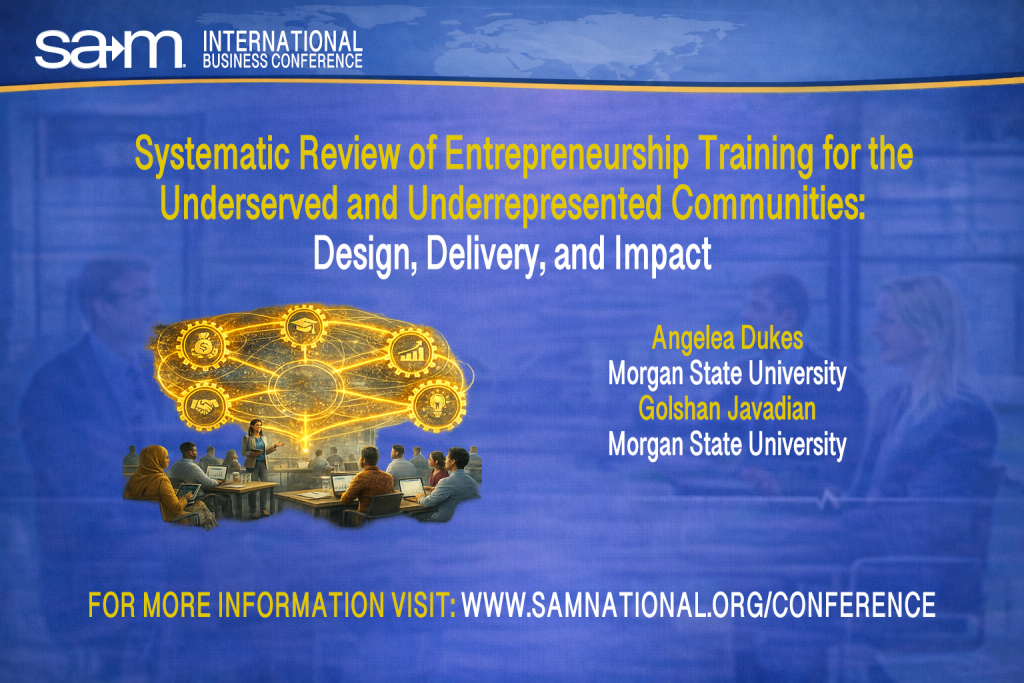
Entrepreneurship training has emerged as a powerful mechanism for addressing systemic economic inequities faced by underserved and underrepresented communities. Yet while such programs are widely promoted, there is less clarity about which designs, delivery methods, and support structures actually lead to sustained entrepreneurial success. This accepted scholarly research presentation offers a systematic review of entrepreneurship training programs aimed at marginalized populations, examining what works, what falls short, and where future efforts should be focused.
Drawing on a structured review of 32 peer reviewed studies using the PRISMA framework, the research analyzes entrepreneurship training initiatives implemented across diverse cultural and geographic contexts. The review highlights the importance of culturally responsive program design, experiential learning models, and mentoring as critical components in strengthening entrepreneurial self efficacy and improving short term economic outcomes for participants.
At the same time, the study identifies persistent gaps in program effectiveness. Many initiatives lack long term evaluation of business sustainability, offer limited access to capital, and underutilize community driven approaches that could strengthen trust and relevance. Programs that incorporated Indigenous knowledge systems, addressed gender specific barriers, or targeted women in STEM fields demonstrated stronger outcomes in resilience, persistence, and economic advancement.
By synthesizing global research on minority entrepreneurship education, this presentation positions training programs not only as skill building interventions, but as vehicles for social mobility, inclusion, and generational wealth creation. The findings call on policymakers, educators, and practitioners to design inclusive entrepreneurship programs that address both technical capability and structural inequality.
This session is especially relevant for scholars and practitioners interested in entrepreneurship, economic development, and equity centered innovation. Attendees will gain evidence based insights into how entrepreneurship education can be designed to deliver lasting impact for underserved communities.
Authors and Affiliations
Angelea Dukes, Morgan State University
Golshan Javadian, Morgan State University
Join us at the SAM International Business Conference to engage with this research and explore how entrepreneurship training can be reimagined as a catalyst for inclusive economic growth. Learn more at www.samnational.org/conference