
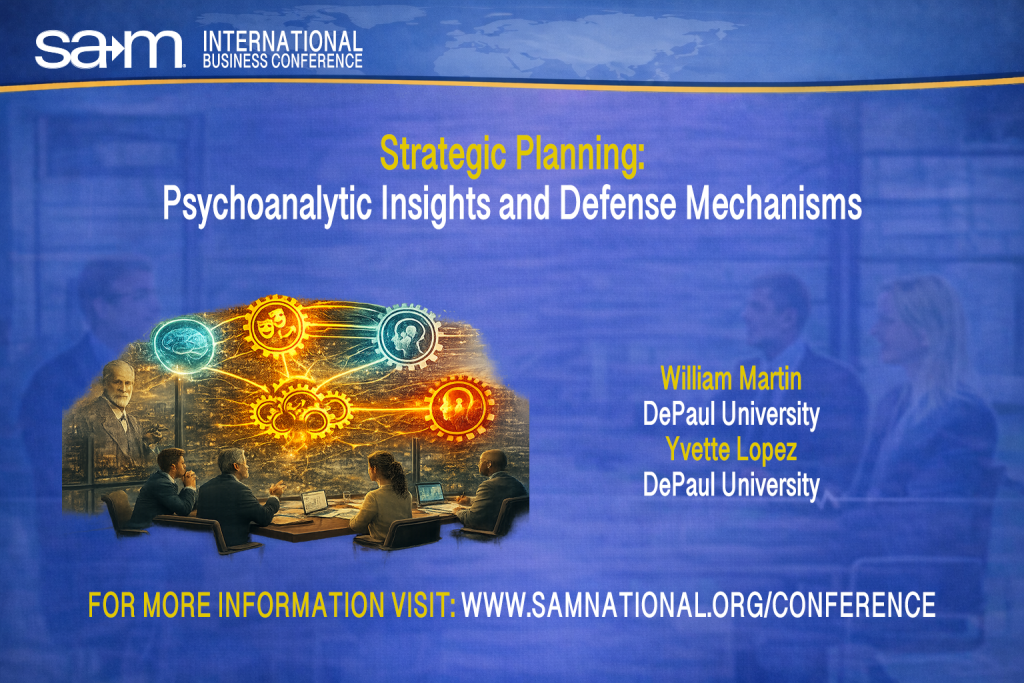
Strategic planning failures in today’s volatile, uncertain, complex, and ambiguous environment are often attributed to flawed data, weak forecasting, or poor execution. This accepted scholarly research presentation challenges that assumption by examining how anxiety and unconscious defense mechanisms shape, distort, and sometimes derail strategic decision making inside organizations. Rather than focusing on technical shortcomings, the research reframes strategy as a deeply human process influenced by emotional and psychological dynamics.
Drawing on psychoanalytic theory and an integrative review of interdisciplinary research, the study explores how defense mechanisms operate at individual, interpersonal, and organizational levels. The authors demonstrate how patterns such as avoidance, projection, groupthink, and escalation of commitment emerge under pressure and suppress dissent, limit adaptability, and undermine strategic learning. These dynamics often persist unnoticed, even in organizations with experienced leadership teams and robust planning frameworks.
Central to the presentation is a multilevel ABC framework that traces the Antecedents, Behaviors, and Consequences of defensive responses in strategic contexts. This diagnostic model helps leaders and scholars identify the conditions that trigger defensive behavior, understand how those behaviors manifest in meetings and governance processes, and assess their downstream effects on decision quality, implementation, and organizational health. By making these invisible forces visible, the framework offers a practical lens for improving strategic inquiry and ethical responsibility.
The research positions organizational health not as a static outcome, but as a strategic capability rooted in the ability to regulate anxiety, sustain psychological safety, and remain open to challenge and learning under pressure. Through reflective practitioner inquiry and cross-disciplinary synthesis, the study bridges strategy, leadership, organizational behavior, and mental health research to generate testable propositions and actionable insights.
Designed for scholars, leaders, and governance professionals, this session provides new conceptual tools for understanding why strategy processes fail and how organizations can build resilience by engaging, rather than avoiding, the emotional realities of decision making. Attendees will gain a deeper appreciation for strategy as practice and leave with frameworks that connect theory, research, and lived managerial experience.
Authors and Affiliations
William Martin, DePaul University
Yvette Lopez, DePaul University
Join us at the SAM International Business Conference to engage with this research. This presentation will be delivered virtually, offering participants an opportunity to explore how psychoanalytic insights can strengthen strategic planning and organizational adaptability.
Register to attend at www.samnational.org/conference and be part of the conversation on managing healthy organizations under pressure.