
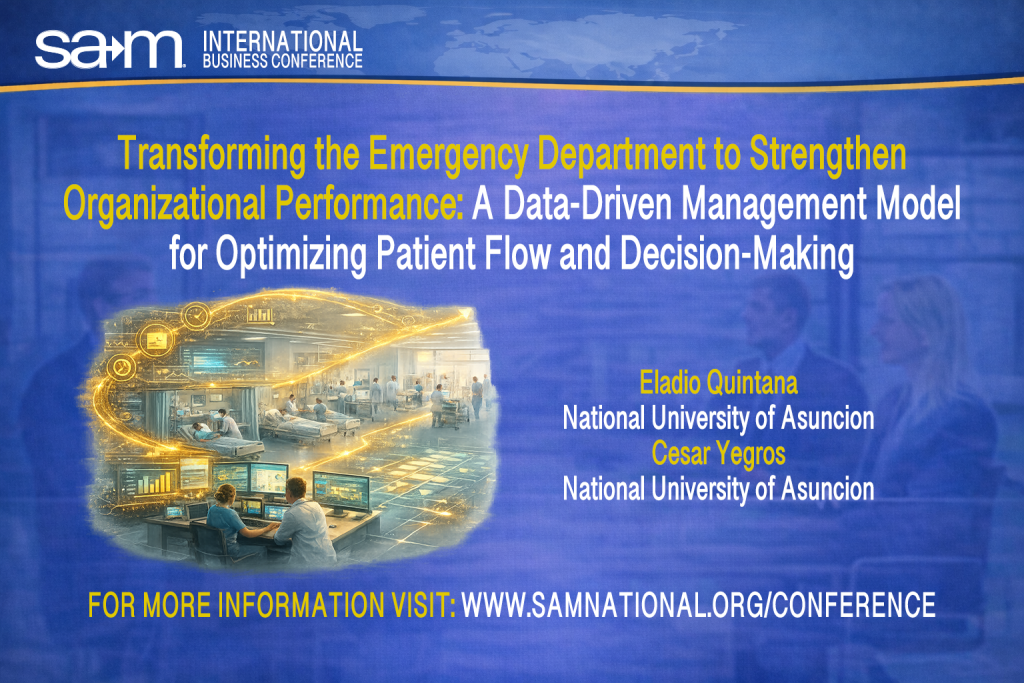
Emergency Departments sit at the center of hospital performance, shaping patient experience, staff workload, and system-wide capacity in real time. Yet in many low and middle income settings, persistent inefficiencies in intake, triage, transfers, and bed assignment create bottlenecks that ripple across the organization. This accepted scholarly research poster presentation introduces a data-driven management model designed to strengthen decision-making and optimize patient flow in the Adult Emergency Department of a major reference hospital in Asunción, Paraguay.
The project begins with a functional analysis of key operational processes, including patient intake, triage, internal transfers, diagnostic routing, and bed assignment. By examining how these processes interact, the research identifies structural bottlenecks and systemic inefficiencies that limit throughput and contribute to organizational strain. Rather than treating the Emergency Department as a purely clinical unit, this work reframes it as a strategic operational system where management choices can directly influence performance outcomes.
Methodologically, the study integrates quantitative analysis of institutional flow data with qualitative insight from frontline staff. This hybrid approach allows the model to capture both measurable patterns and the lived realities that shape day-to-day operations. Building on this analysis, the work includes early development of a digital management tool that combines real-time bed visualization with machine-learning-assisted triage support, strengthening prediction, prioritization, and resource allocation at the point of need.
The expected outcomes focus on organizational performance improvements that matter to both leaders and care teams. These include reducing variability in waiting times, improving predictability of patient flow, making more efficient use of existing resources, and enhancing coordination across units. Importantly, the model emphasizes performance gains without requiring major physical infrastructure expansion, making it especially relevant for hospitals working under resource constraints.
Designed for scholars, healthcare managers, and operational leaders, this poster highlights how data-supported decisions and streamlined process design can strengthen hospital resilience. Attendees will gain insight into scalable, management-oriented approaches for improving Emergency Department performance while supporting healthier, more sustainable organizational systems.
Authors and Affiliations
Eladio Quintana, National University of Asuncion, Paraguay
César Yegros, National University of Asuncion, Paraguay
Join us at the SAM International Business Conference to engage with this research. This poster will be presented in person, offering attendees an opportunity to explore how data-driven operational strategy can improve patient flow, strengthen decision-making, and support hospital performance.
Register to attend at www.samnational.org/conference
and be part of the conversation shaping healthier, more resilient healthcare organizations.