
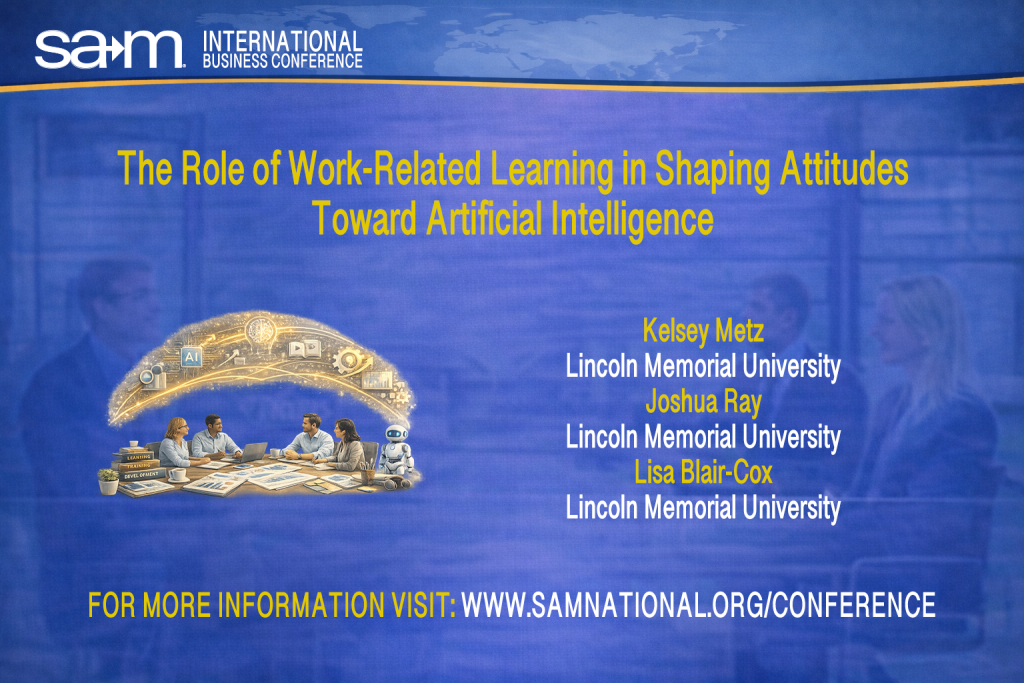
As artificial intelligence becomes more deeply embedded in organizational systems, employee attitudes toward AI increasingly shape whether these technologies are adopted successfully or resisted. This accepted scholarly research presentation examines how work-related learning influences employee perceptions of AI and whether those relationships differ across traditional, remote, and hybrid work settings.
Drawing on survey data collected from full-time employees across a range of work arrangements, the study uses partial least squares structural equation modeling to explore how both formal and informal learning experiences shape employee evaluations of AI in the workplace. The findings reveal that work-related learning plays a meaningful role in how employees assess AI, but not all learning experiences influence attitudes in the same way.
Formal learning initiatives were found to predict both positive and negative evaluations of AI. While structured learning environments help employees build competence and confidence with AI tools, they can also increase awareness of potential risks, limitations, or ethical concerns. In contrast, informal learning experiences were shown to support favorable evaluations of AI without increasing negative responses, suggesting that peer learning, experimentation, and on-the-job exposure may foster openness without amplifying apprehension.
Importantly, these relationships remained consistent across traditional, remote, and hybrid work settings. This finding suggests that how employees learn may matter more than where they work when it comes to shaping attitudes toward emerging technologies. The study contributes to organizational learning and human resource management literature by integrating learning processes, work context, and employee attitudes toward AI within a single empirical framework.
Designed for scholars, educators, and practitioners, this session offers research-backed insights into how organizations can design learning strategies that build AI capability while addressing employee concerns. Attendees will gain practical guidance on balancing formal training with informal learning opportunities to support responsible AI adoption and workforce readiness.
Authors and Affiliation
Kelsey Metz, Joshua Ray, and Lisa Blair-Cox
Lincoln Memorial University
Join us at the SAM International Business Conference to engage with this timely research. This presentation will be delivered virtually, allowing participants from anywhere in the world to attend, ask questions, and explore how learning shapes employee attitudes toward artificial intelligence.
Register to attend the conference at www.samnational.org/conference and take part in conversations shaping the future of work, learning, and technology.