
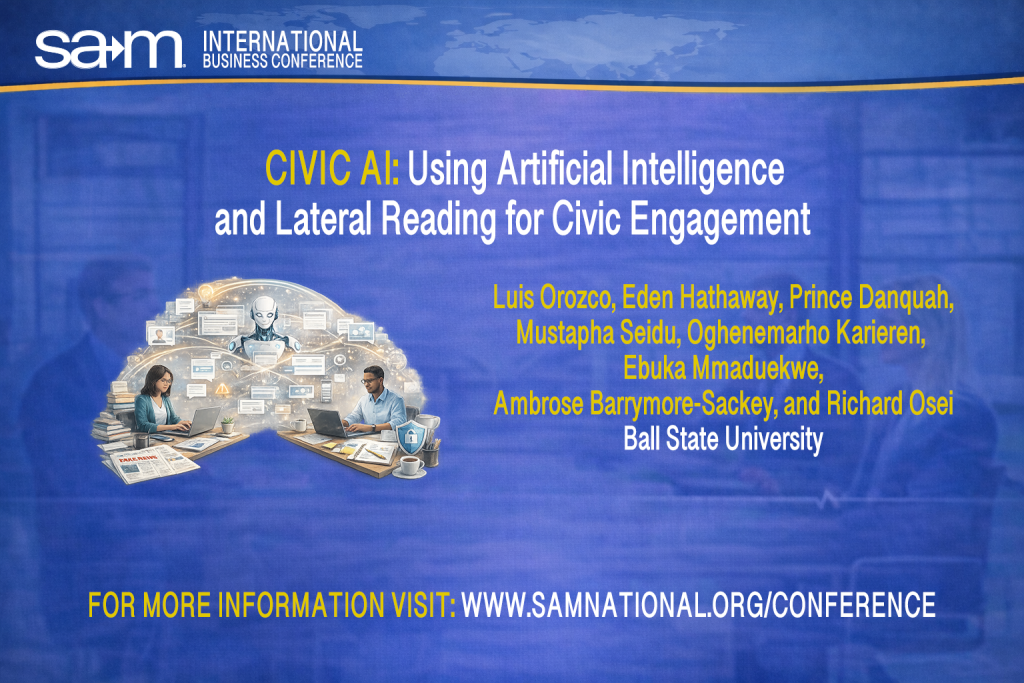
Misinformation spreads faster than ever, and communities are increasingly relying on social media and digital platforms for news and civic information. That shift has expanded access, but it has also intensified polarization by making it easier for inaccurate or misleading claims to circulate unchecked. This accepted presentation explores how communities can strengthen civic engagement by combining two practical approaches: lateral reading and artificial intelligence tools for verification.
Lateral reading is the technique professional fact-checkers use to evaluate credibility. Instead of staying on one webpage and judging it by design cues or persuasive language, readers leave the original source to cross-check claims using additional sites, original reporting, and reputable references. The presentation argues that this outward, verification-first approach helps people better assess authorship, credibility, and bias before treating information as valid.
The session also introduces Civic AI Engagement, the strategic use of AI tools to support more informed and inclusive participation in civic life. Tools such as ChatGPT and Perplexity can help users generate verification questions, compare competing evidence, identify credible sources to consult, and summarize findings quickly. Used responsibly, these tools can reduce the friction of fact-checking and help community members slow down, verify claims, and engage in civic dialogue with better information.
Grounded in a contextual narrative and literature review of research published between 2010 and 2024, this session presents a five-step framework that integrates lateral reading with AI-supported verification. Participants will walk through practical examples and learn how to apply these methods in real time using browser-based strategies and AI prompts. The workshop includes take-home resources, including a handout and slide deck, designed to support implementation in schools, libraries, and other civic spaces.
The session also addresses ethical considerations, including privacy and bias in AI outputs. Participants will learn how to use AI tools in ways that protect personal information and avoid overreliance on a single model or source. By the end, attendees will leave with practical skills to identify misinformation, reduce polarization, and promote a stronger culture of digital responsibility.
Authors and Affiliations
Luis Orozco, Ball State University
Eden Hathaway, Ball State University
Prince Danquah, Ball State University
Mustapha Seidu, Ball State University
Oghenemarho Karieren, Ball State University
Ebuka Mmaduekwe, Ball State University
Ambrose Barrymore-Sackey, Ball State University
Richard Osei, Ball State University
Sunday Balogun, Ball State University
Join us for this virtual workshop at the SAM International Business Conference, where you can engage with timely research and practical tools for strengthening informed civic participation. Attend in-person in Rhode Island at the New England Institute of Technology or join virtually from anywhere in the world.
Learn more and register to attend at www.samnational.org/conference.