
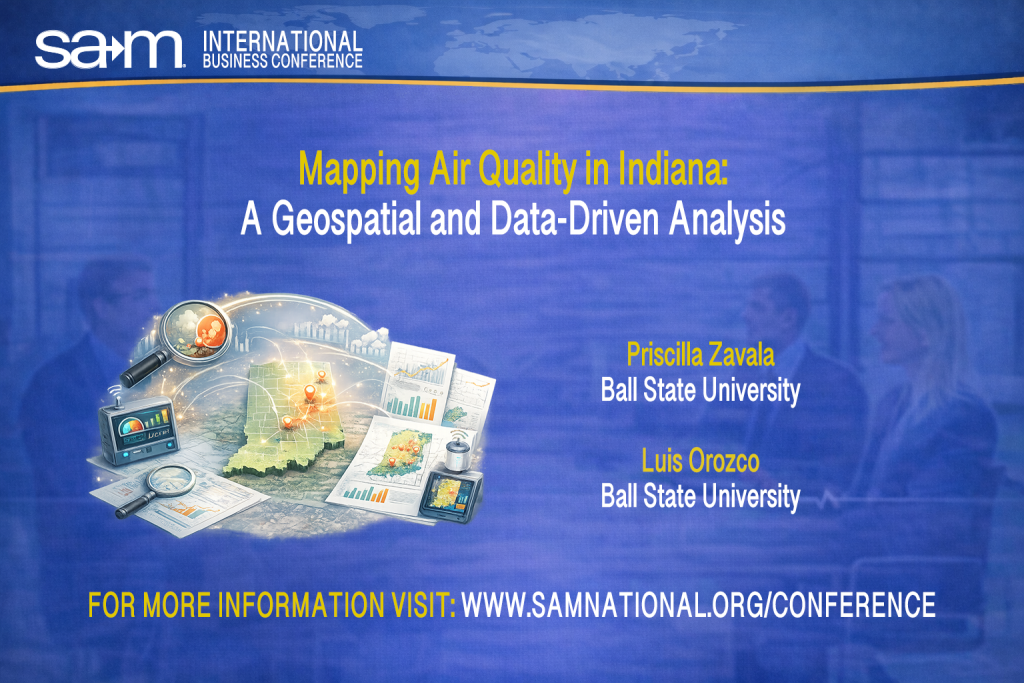
Understanding air quality at the community level is essential for improving public health outcomes and supporting data-informed environmental decision-making. This accepted presentation examines air pollution disparities across Indiana using a geospatial and data-driven approach that integrates environmental, demographic, and health-related data.
The study analyzes exposure to key pollutants, including PM2.5, NO₂, and O₃, drawing on datasets from the Environmental Protection Agency and the U.S. Census Bureau. Using statistical analysis, regression modeling, and geospatial tools such as Tableau and Python’s GeoPandas, the research visualizes how pollution levels vary across regions and intersect with population characteristics.
Initial findings indicate elevated PM2.5 concentrations in several central Indiana counties, including Marion, Hamilton, Boone, Hendricks, and Tipton, as well as border counties such as Lake and Vigo. In multiple areas, pollution levels approach the EPA’s annual exposure threshold, highlighting disproportionate environmental risk across communities.
The presentation concludes with an interactive dashboard that enables users to explore localized air quality conditions. By translating complex environmental data into accessible visual tools, this research supports community awareness, environmental management, and public health planning.
Authors and Affiliations
Priscilla Zavala, Ball State University
Luis Orozco, Ball State University
Join this virtual presentation at the SAM International Business Conference to explore how geospatial analysis and environmental data can support healthier, more equitable communities.
Learn more and register to attend at www.samnational.org/conference.