
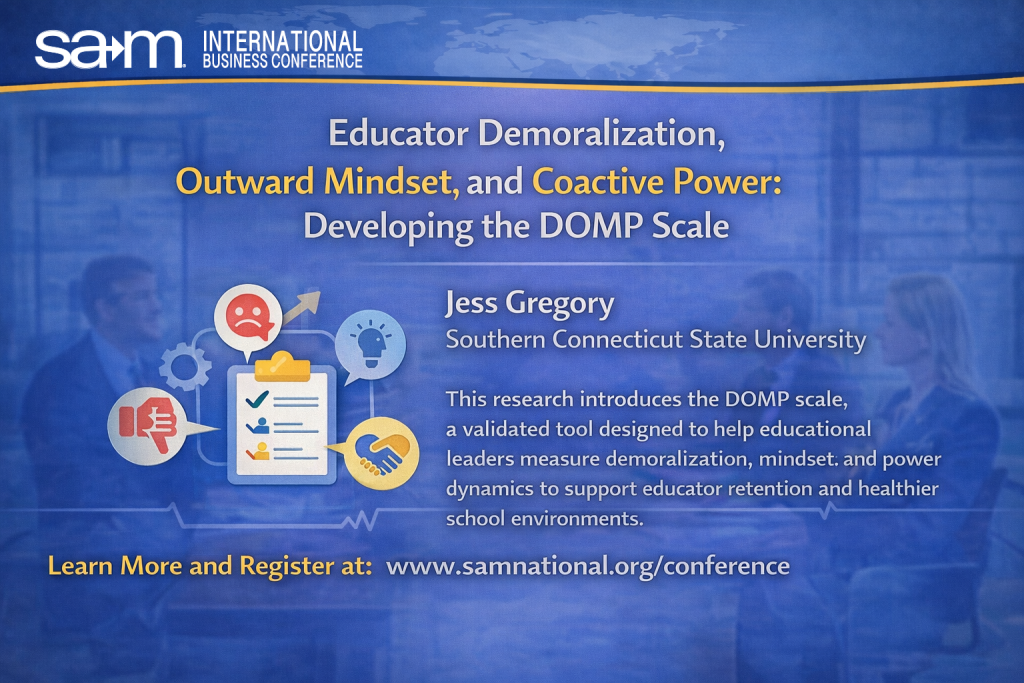
Educator demoralization continues to challenge schools and universities across the United States, contributing to burnout, disengagement, and persistent teacher shortages. This accepted scholarly research presentation introduces the next iteration of the DOMP scale, a research-based instrument designed to independently measure educator demoralization, outward mindset, and coactive power as distinct but related constructs.
Grounded in the context of Connecticut’s ongoing teacher shortage, this study responds to a critical leadership gap. Educational leaders often recognize the symptoms of systemic strain but lack reliable tools to measure progress or evaluate interventions aimed at improving educator morale and retention. The DOMP scale addresses this need by offering a structured way to assess the underlying dynamics that shape educators’ experiences within complex policy and organizational environments.
Using exploratory factor analysis across two rounds of survey data, the researchers refined the DOMP V3 scale into three clearly defined factors: Demoralization, Mindset, and Power. Statistical testing confirmed the robustness of the instrument, with strong reliability scores across all three dimensions. The findings demonstrate that demoralization, outward mindset, and coactive power can be measured independently, offering leaders and policymakers a more precise lens through which to examine organizational climate and leadership effectiveness in educational settings.
The presentation emphasizes the practical implications of the DOMP scale for educational leadership. By providing a validated measurement tool, the research supports data-informed decision making around retention strategies, leadership development, and policy reform. The study also outlines future research directions, including validation with larger and more diverse samples and exploration of how the DOMP scale can be used to monitor change efforts over time.
Author and Affiliation
Jess Gregory, Southern Connecticut State University
Join us at the SAM International Business Conference to engage with research that addresses one of the most pressing challenges in education today. This presentation will be delivered in person, offering opportunities for discussion around leadership, organizational behavior, and educator well-being.
Register to attend the conference at www.samnational.org/conference and be part of the conversation on building healthier, more sustainable educational environments.